
Winter Waters
If you can’t be on the water, it’s wonderful to have a boat project and boat dreams to see you through the winter.
Article by Dan Nelson
Growing up in the Pacific Northwest, close by the Salish Sea, you could sail all winter, given the right attitude and clothing and an adult with a boat needing a crew. But here in Vermont, where most boats are under cover in November, the water in February is either white and falling out of the sky or frozen. The ice in local lakes is a foot thick or more, and most of them won’t be ice-free until mid-March. Now that I’m retired, I aim to have a daily outdoor adventure. Some are small and local, and some are extended and further afield, but for a couple of months now the daily joys of slipping into the kayak or the fun of launching the dory and raising the sail have been by necessity replaced by the satisfactions of skiing, which is another kind of floating on water.
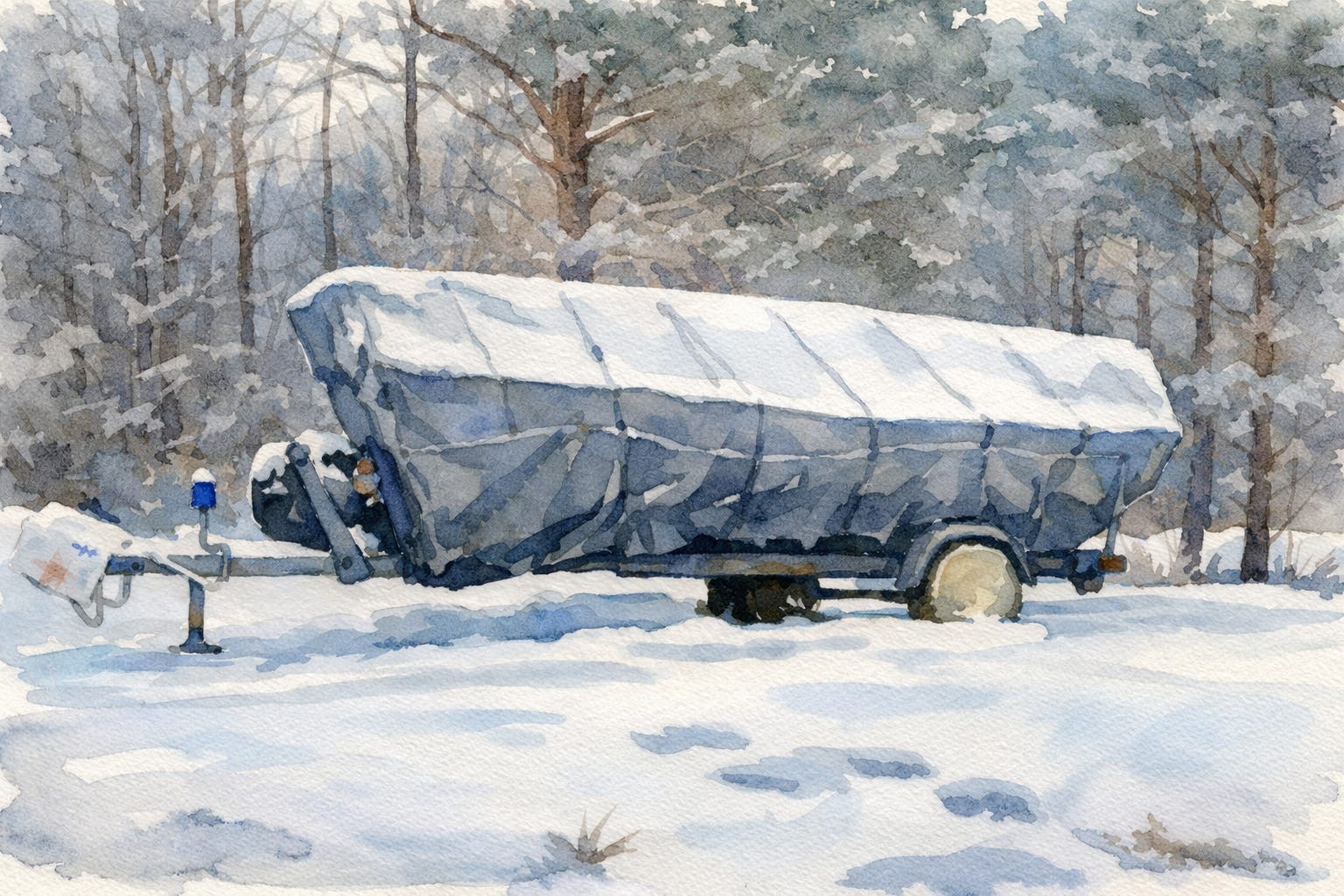
But I still have a winter boating season of sorts. From the kitchen and from my chair between the bookcase and the fireplace I can see out the windows to the dory on its trailer.
But I still have a winter boating season of sorts. From the kitchen and from my chair between the bookcase and the fireplace I can see out the windows to the dory on its trailer. The tarp on its cobbled-together frame is taut enough so that the snow slides off, mostly. Admiring that, I find myself musing over how best to mount something on the interior hull to support a forward thwart for a second rowing station, how far it should be from the edge of the first thwart, how I could adapt it for a sleeping platform for some extended cruising in coastal Maine or New Brunswick, and whether I’d be better off with a store-bought pop-up tent that might somehow fit in the boat or with a tarp hung over the sprit (no boom on my rig) secured somehow to the mast and a crutch at the stern. But then how would I secure the tarp below the gunwales? Giving up, for the moment, on that compelling conundrum, I start wondering about a different lacing pattern for lashing the sail to the mast that would allow me to lower it more easily for reefing. Or would mast hoops make sense? And thinking of coastal cruising and camping, would beach rollers be a good investment?
There are a few canoes and kayaks in the boat shed (winner of the competition with a hypothetical garage for space and money), with no room for any more unless I manage to sell one or two. But which one? The beautifully restored antique wood and canvas canoe that seems to have gained considerable weight over the past few years and is really too heavy for me to manage any more? Was it really that long ago that I regularly hefted it on and off the roof rack and carried it across portages? Or the sailing canoe that doesn’t get enough use? Or the even heavier 20-foot XL Tripper that is perfect for northern Maine rivers like the Allagash, St. John and West Branch—but when will I do another trip up there? This all prompts deep dives into various canoe websites and online marketplaces, which in turn has me more interested in expanding rather than reducing the fleet at home—not to mention reflections and day dreams about trips taken and imagined.
Grey winter afternoons are improved and brightened by catalogues, especially from the Maine Wooden Boat School and Chesapeake Light Craft. If I had more time and money, I’d go to wooden-boat-building summer camp every year. I surprised myself with the success of my first build, at home during Covid. A couple summers later, the allure of completing a second build in week under the guidance of an instructor was irresistible, and I was hooked the minute I stepped onto the boat school campus. I haven’t been back, although every fall I pour over the course offerings and boat descriptions and make grand plans. There’s always next year.
And then there’s reading: This fall during recovery from some surgery (carefully scheduled during “mud season” between boating and ski seasons), there were William Tilman’s sailing exploits (how did he survive so many close calls and his own haphazard navigation?), Tristan Shandy’s yarns (verisimilitude is probably beside the point), and Arthur Ransome’s Swallows and Amazons (a decent sailing primer spliced into the delightful story).
This winter, having largely forgotten the messes I’ve made with fiberglass and epoxy and the hours (days, weeks…) spent sanding, I’ve started another home build, and I go to bed with hands sore from twisting and being poked by wire “stitches,” mulling over the pros and cons of tack-welding with superglue vs. an epoxy mix, and techniques for clean, beautiful fillets. And should I aim for a totally bright finish, or paint at least the hull? But if I paint, do I really believe what I read about not needing a primer over the fiberglass? Then there’s the trailer. How can I adapt it to fit the new boat? So many important things to ponder, and such a welcome relief from the constant media barrage of bad news in darkening times.
If you can’t be on the water, it’s wonderful to have a boat project and boat dreams to see you through the winter with no pressure, schedule or deadline other than the goal of launching as soon as local lakes and rivers are ice free again. •SCA•
Dan I'm with you on the more time and $$ - I too would be at the summer classes up in Maine. You've hinted at what boat you have with the sprit and no boom but can you say more? I fought with putting a sprit tent up on my Crawford MS back when I had it. It can be down with running a line under the boat to hold it at the gunwales, just has to be ideal conditions to deploy.
I'm hoping the image above IS NOT AI - then I can admire the person and his or hers water color abilities - delightful! thanks Rob