
The Old Salt Founders Build
Part 1
Article by Greg Willihnganz
On March 2nd, six men joined the staff of the Northwest Maritime Center for the first group build of the Old Salt 15, a new design from Josh Colvin and Brandon Davis. Only five of the six would be taking a boat home at the end of the build. The sixth member of the group was there as an observer/participant who would only stay for the first week of the two-week build. I was the seventh member of this group, there to record the process and learn what I could about the joys and challenges of building your own boat.
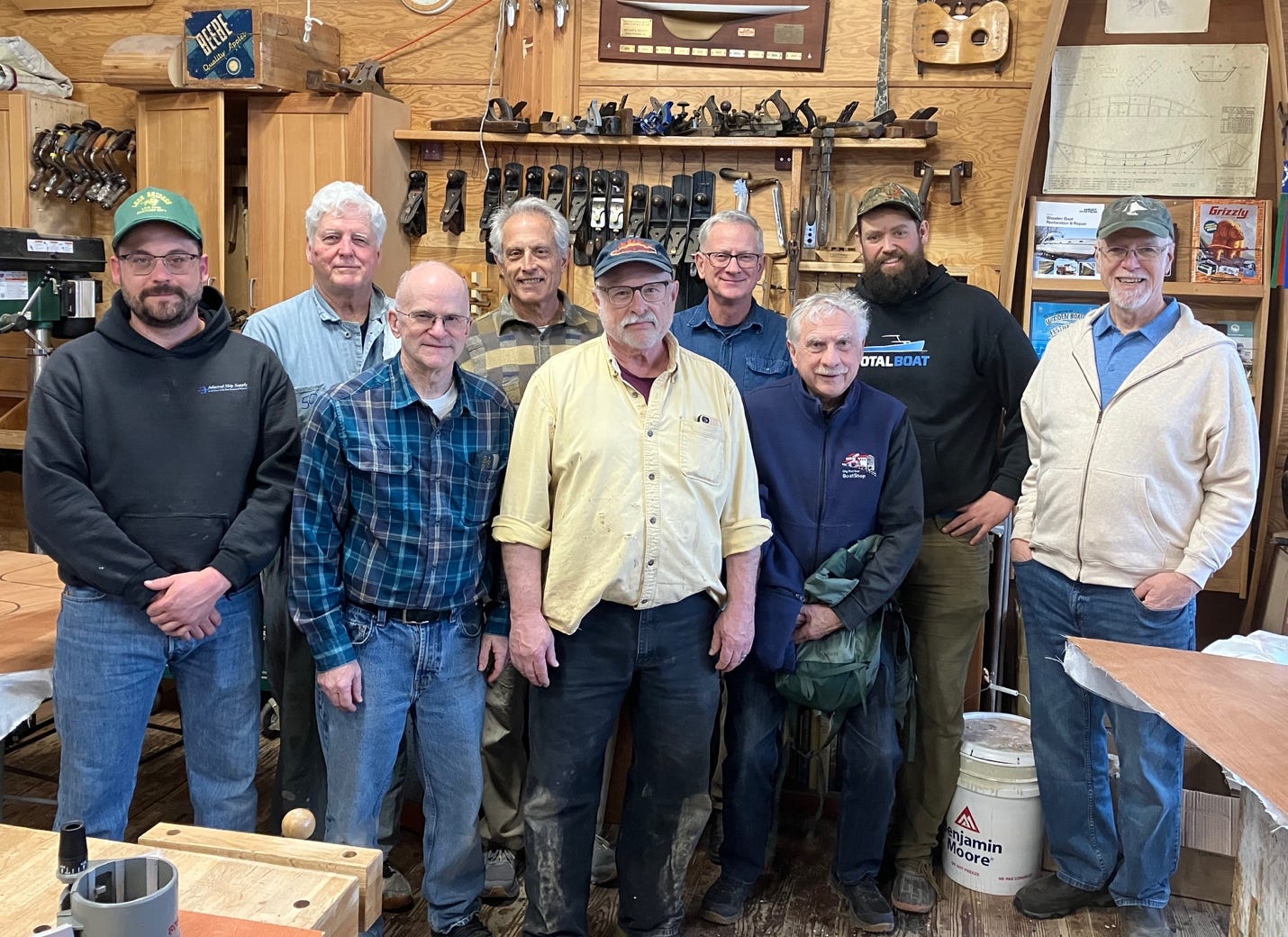
Above, L to R: Tyler (NW Maritime Staff), Brad, Ron, Mark, Nels, Philip, James, Joel (NW Maritime Staff), and Greg
The build was led by Joel Arrington, Boatshop Manager for the Maritime Center, and by far the most skilled and experienced among us. Joel has overseen the building of 250-300 boats in his six years as Boatshop Manager and his knowledge of boat building, bonding resins, and fiberglass installation is encyclopedic. It is reassuring to work with someone who really does have all the answers.
We were building kit boats, which are hardly new. A wonderful article on the Chesapeake Light Craft site gives the history of building boats from kits. It begins with this startling note: “4300 years ago, the Pharoah Khufu was laid to rest with 1,224 pieces of a 143-foot boat, ready to be reassembled when he reached the afterlife.”
Ads for boat kits first appeared back in the 1890s when amateur boat building really began. It increased during the Great Depression, aided by magazines of the era: Popular Mechanics, Popular Science, Rudder, and Yachting, which ran frequent and detailed articles to help the home builder. Companies sprang up offering kits for home building.
A major step forward was the development of marine plywood during the 1940s. New adhesives helped the plywood avoid delamination and allowed the home builder to work with large sheets, rather than narrow strips of solid wood. The panels were attached to frames with screws and soft putty or powdery glues that were mixed with water. But over time, the putty and some early glue products came apart, leading to leaks.
Stitch and glue boatbuilding began in the late 1950s in England when Ken Littledyke sewed sheets of plywood together using fishing line and reinforced the seams with polyester resin. Then in 1962, Jack Holt and Barry Bucknell designed the Mirror dinghy, named after the English newspaper The Daily Mirror. It was stitched together with copper wire with fiberglass tape glued along the seams. The Mirror became very successful and over 70,000 have been built.
In the 1960s, the aerospace industry developed epoxy adhesives and coatings which could be combined with fiberglass to create immensely strong structures and surface coatings. This led to the boom in manufacturing of small fiberglass boats during the ‘60s and ‘70s. By the 1980s, kit boats were being sold with nothing but pre-cut sheets of plywood that could be stitched and taped together without the need for heavy supporting frames.
In the 1990s, computer-driven CNC machines were developed that could cut thin sheets of plywood precisely. As kit development continued, it wasn’t long before 4x8 plywood sheets could be joined together using puzzle joints in place of the traditional scarf joints used with thicker wood. Coating this thin plywood with epoxy and fiberglass cloth made the parts stronger and mutually supportive, eliminating the need for heavy framing.
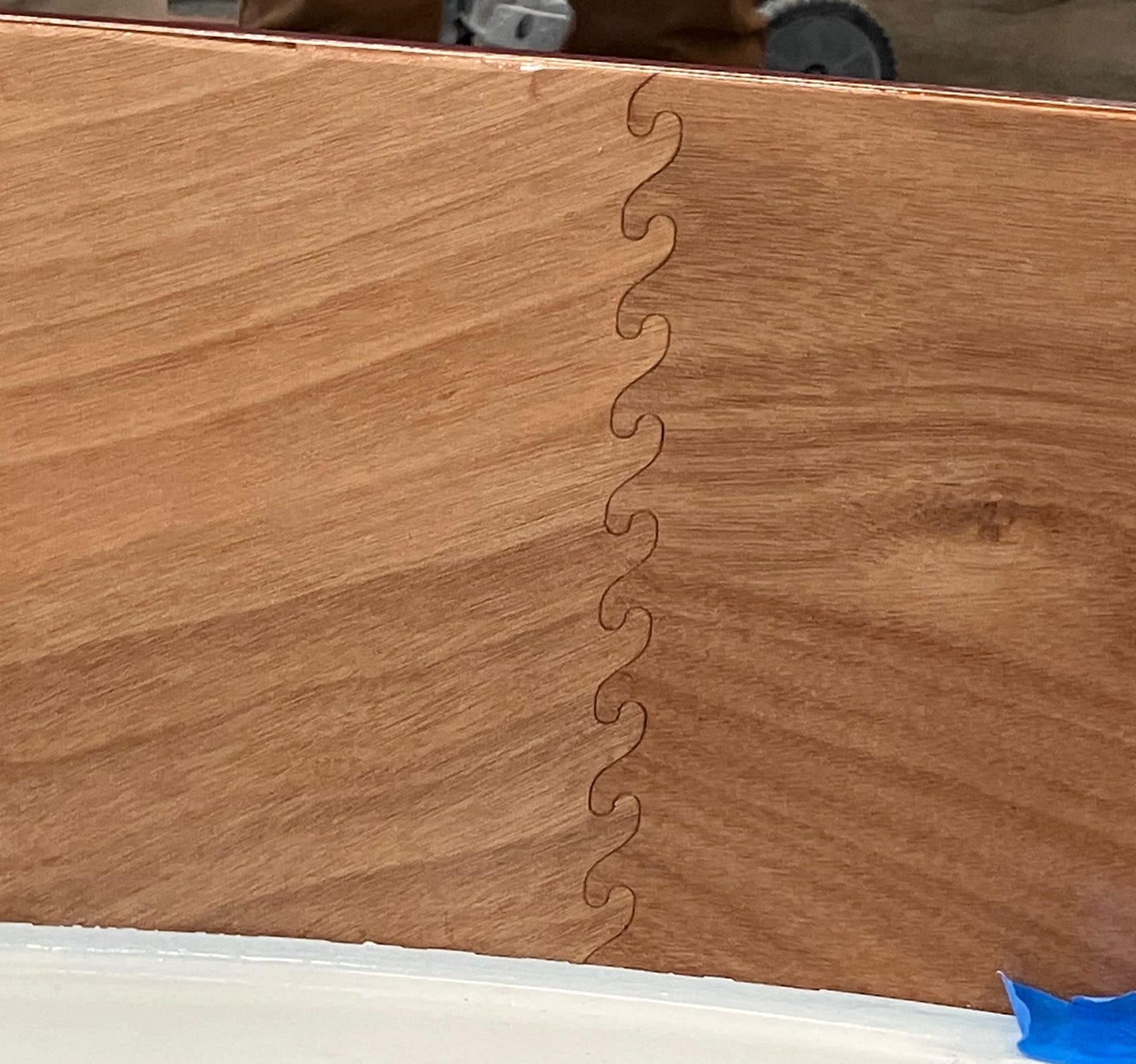
This is the technique we used in building the Old Salt boats. Brandon Davis cut the pieces of Okoume marine plywood for a classic stitch and glue assembly. The plywood sheets were either 4mm, 6mm or 9mm thick, depending on the parts being cut. For added strength, some parts were bonded to other parts, reinforcing the structure.
On our first day in the boatshop, we began with a round robin of introductions, each of us telling a bit about our history in boating and boat building. In addition to the six builders, there were two staff leading the build and two journalists—myself and Larry Cheek, who was writing a piece for WoodenBoat’s online channel. He stayed for three hours, taking notes on a pad, then left us for the rest of the week. He returned on Monday and Friday of the following week.
I was struck by how similar the six builders were: all males, white hair on every head, smart, competent men in their late 60s or 70s, who were now retired from successful careers. All but one of them had built boats before and several had extensive experience building wooden boats and working with fiberglass.
You might wonder why experienced boat builders would pony up the money for this two-week build when they could just order the kits (not available yet, but I’m sure they soon will be) and build the boats at home without the travel and lodging expenses of coming to Port Townsend. There are multiple reasons why taking part in the build is attractive.
First, there is the well-equipped and professionally staffed woodshop at the NW Maritime Center. This facility is a boat builder’s dream with a lot of light, a lot of space, and all the clamps, sawhorses, tools, and supplies needed to create boats. There is an attached machine shop with four sanding machines (vertical and horizontal), multiple band saws, table saws, drill presses, and huge units for air handling and cleaning.
The main working area measures something like 40 feet by 140. Shelving and cabinetry line the walls and there are moveable work benches and an overhead crane if boats need to be flipped over.
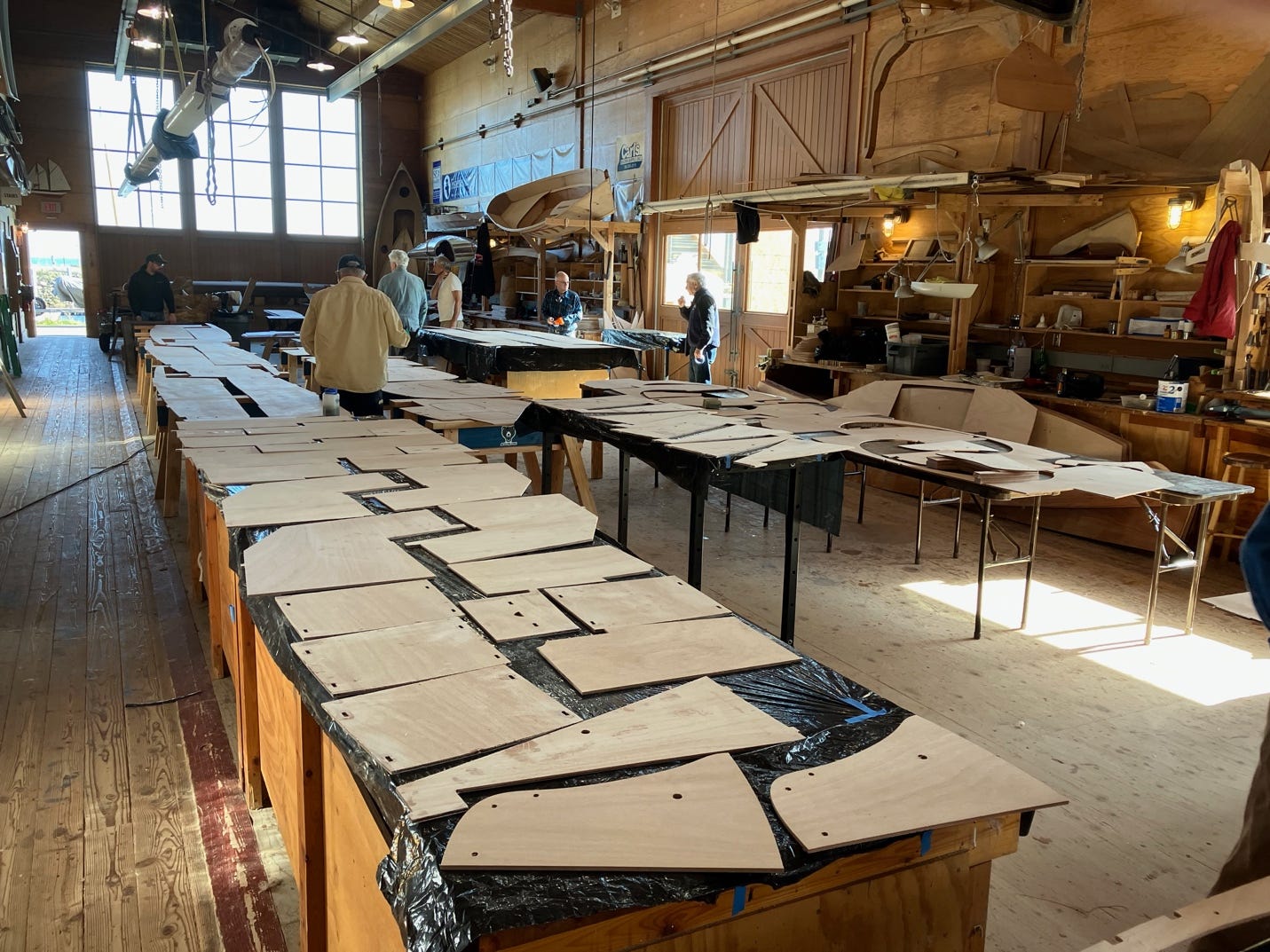
There are boats hung overhead, some finished, some in process, and there are projects at the end of the workshop that are being worked on by other groups and individuals. Two local artisans have designated work areas along one bench, and one has an adorable dog, Peaches, who is a regular tenant in the shop.
Another reason building in this setting is attractive is the leadership and support provided by Joel, the Boatshop Manager, and his assistant, Tyler. Joel has worked for many years with Brandon Davis and Josh Colvin and this team can handle any situation that comes up short of a hurricane destroying the shop. They have created, designed, and built other kit boats like the SCAMP, the Scout, and the Skate 15, learning many lessons along the way.
Building in a group is also a high motivator. The camaraderie that develops between builders spurs everyone to work a bit harder, to take care that things are done right, and to help out wherever they can. Friendships develop fast and this was certainly true of the Founders Build. We quickly learned that everyone was competent and dedicated to the task, and no one tried to take over parts of the work or take command. Even Joel, who really was in command, showed us how to do the work and let the group figure it out without micromanaging.
Another advantage of doing a group build is that builders can do what they do best. I was impressed with how the builders took over tasks based on their individual skills, but also did whatever was necessary to keep the process moving.
After we’d done introductions that first day, Joel took us on a tour of the shop showing us where tools and supplies were stored, where to hang our gear, and how to find the bathrooms. We got specific instructions on personal protective equipment (PPE), where it is stored and when to wear it. Joel emphasized that sanding dried fiberglass embedded in resin brings nasty micro fibers up into the air where we breathe.
We were warned not to sweep the shop floor with brooms, but rather to use the shop vacs which have HEPA filters. The orbital sanders have hoses connecting them to the shop vacs and when the sanders are plugged into the shop vacs, they automatically start the vacs to suck up as much of the sanding dust as possible.
After our introductory tour, Joel gave us an in-depth demonstration of how to lay and reinforce fillets joining two sheets of plywood together. First, he showed us the Total Boat resin and hardener mixer which requires hand pumping, but gives an accurate measure of how much resin and how much hardener are being dispensed.
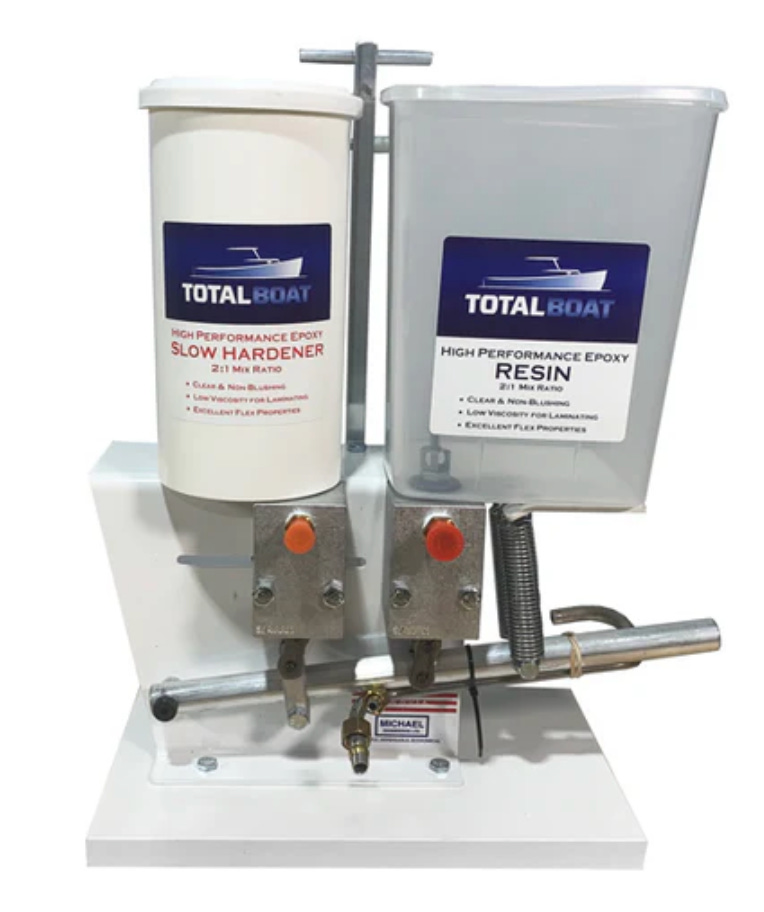
For the epoxy we were using, the resin to hardener proportion was 2 to 1.
Other epoxy products have different ratios. One interesting opinion Joel shared is his belief that it doesn’t actually matter which brand you use, they all are amazingly strong. Different brands are somewhat thicker or can be cloudy, but all create very tight bonds.
Joel uses the dispenser to half fill a 16-20 oz. plastic cup like you might buy potato salad in at the grocery. Then, he warned us, you must stir the resin and hardener together for a full 90 seconds. He emphasized we should look at the clock; a minute and a half is a lot longer than you might think. Stirring should be done from the bottom of the cup upwards and not just in a circular motion. Special attention needs to be given to the sides and the bottom of the cup to be sure all of the resin and hardener are blended thoroughly.
He then added wood flour to thicken the mixture into filleting material. Wood flour is just very finely ground wood fibers that turn the epoxy into a paste. This was done slowly with a lot of mixing until the final product reaches the classic “peanut butter” consistency.
Some authorities suggest that the filleting material can be dispensed using a plastic bag, but Joel has had more success using a cake decorator’s triangular plastic bag. Pack the bag with material, twist the large end and hold it closed or tie it off with a twist tie, and carefully cut the tip to the desired opening depending on the size bead you wish to lay.
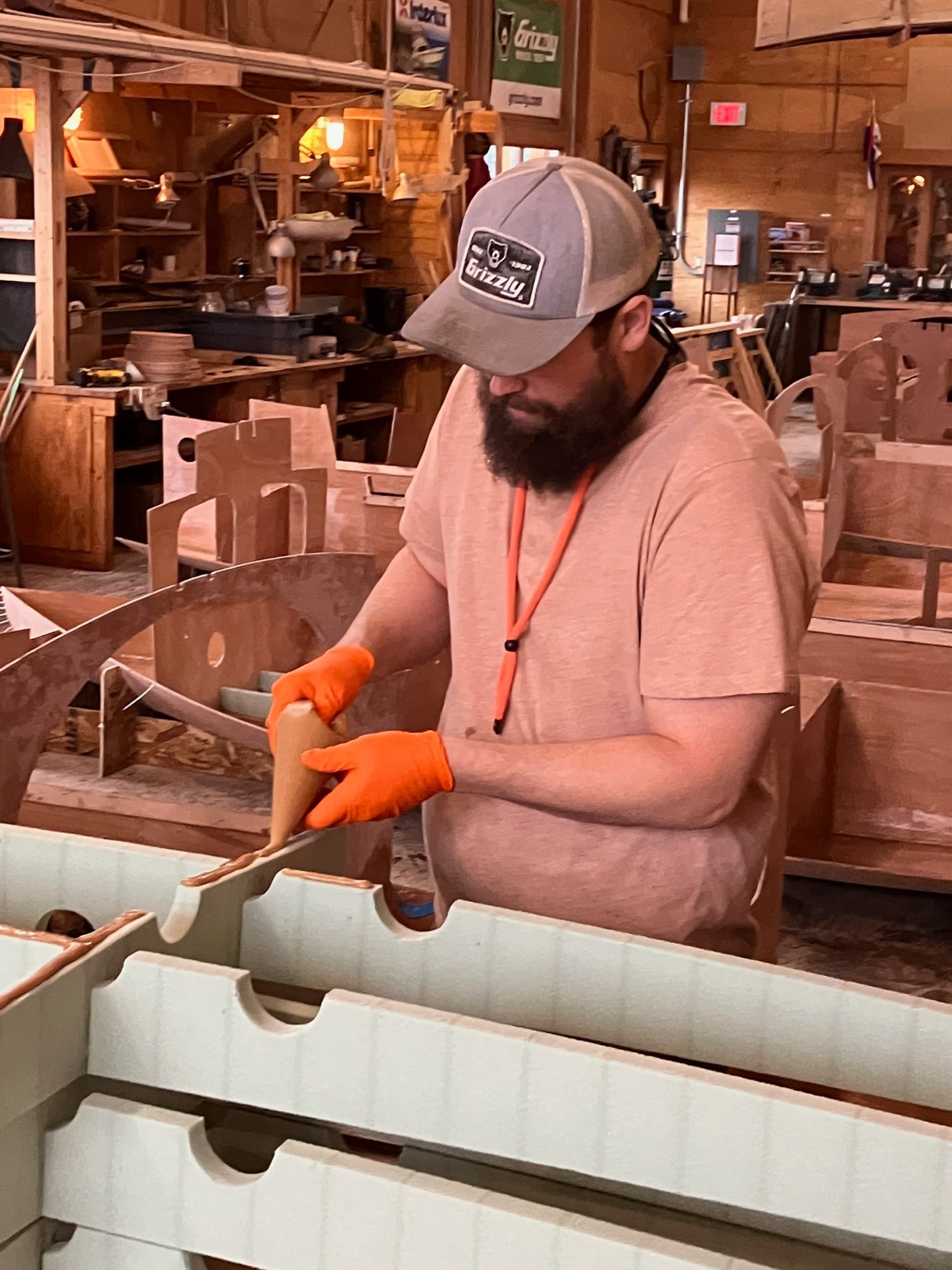
In the photo above, Joel is laying a wide bead on the closed-cell foam baffles that will be placed in the water ballast tanks beneath the cockpit deck. But in joining parts like bulkheads, he cuts the opening in the triangular bag much smaller to lay a perfectly rounded bead about a quarter of an inch out from the joint. He then uses a popsicle stick or tongue depressor, depending on the angle of the joint, to press the epoxy into the joint and leave a concave line of epoxy. For perfect 90 degree joints, he uses a stick with a smaller diameter, but for angled joints of say 140 degrees, he uses a tongue depressor or a stick with even a wider rounded end.
The first pass in pushing the epoxy into the joint is done with the rounded stick at a low angle. Then for a second pass, he raises the packing stick so that it is almost at 90 degrees from the joint. Then he carefully removes any excess that has squeezed out of the joint. Joel emphasizes that it is critical to leave the joints as smooth as possible because sanding these joints is very difficult and time consuming.
With the epoxy fillet now placed in the joint, it is reinforced with a 2” wide strip of fiberglass cloth. The length is cut to fit the joint, then the strip is laid on a plastic bag (epoxy will not stick to a shiny surface) where first one side, then the other, are covered in epoxy. The strip is rolled into a small roll and carefully laid across the filleted joint. After it is smoothed into place, a disposable brush is used to tap down the tape to eliminate air bubbles and ensure adhesion. The brush is never used to brush along the tape which might distort the lay of the tape or create creases, it is just used to tamp down the fiberglass into the epoxy.
We finished Day One using epoxy to bond the puzzle joints that turned eight-foot plywood sheets into the 15-foot sides of the boat. Done with strips of plastic bags beneath the joints, we were shown how to draw the brush across the tops of the puzzle curves to let the epoxy run down into the joints. Both sides of the joints were carefully impregnated with epoxy and then pushed and, when necessary, pounded into place.
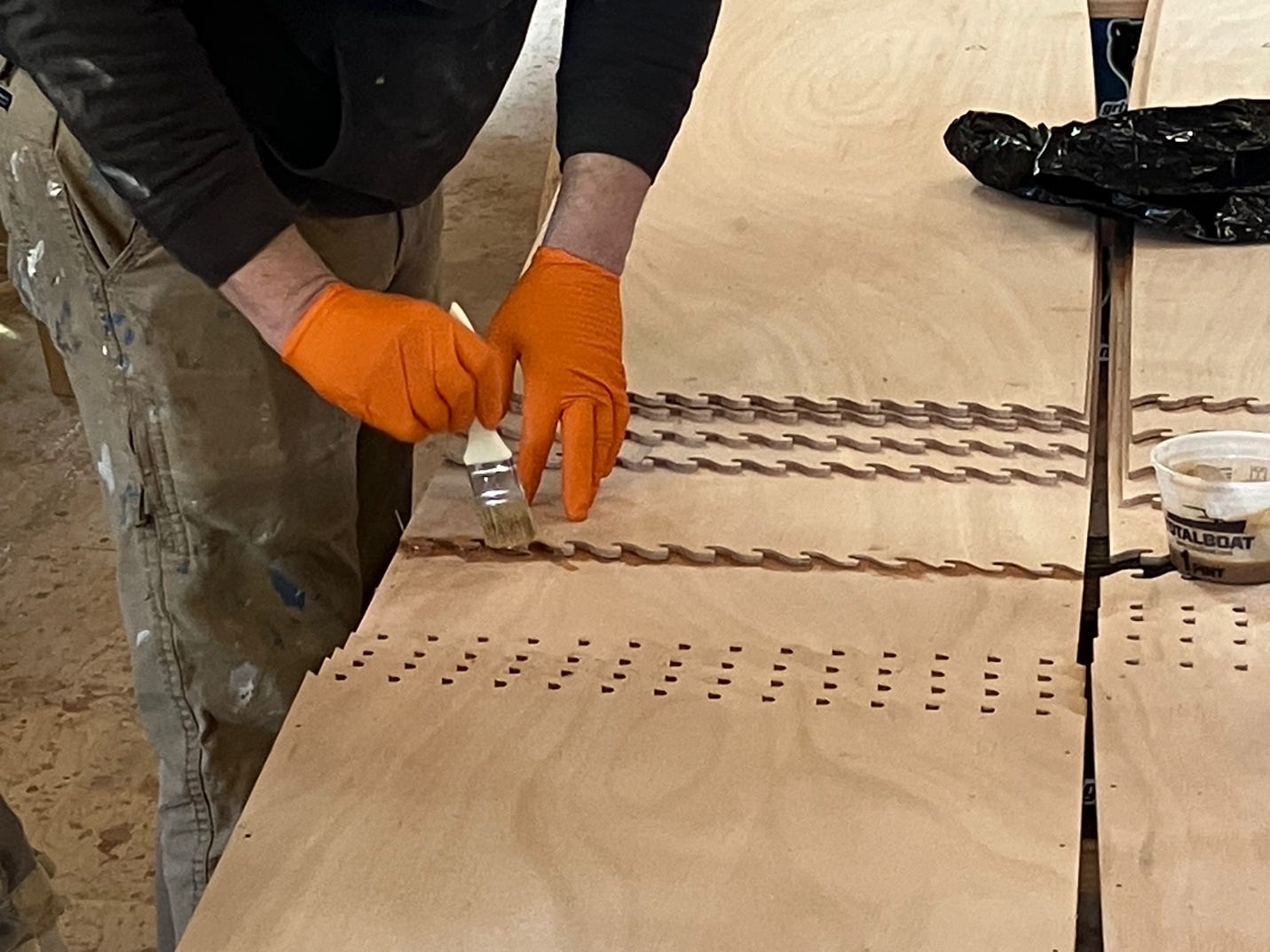
It was a good day’s work with a lot of learning for both the veterans and for the few of us who had never worked with epoxy and fiberglass. •SCA•
Stay tuned for part 2.
Great article Greg. You really captured the key details in building a stitch and glue craft. Thank you!