
The Dutiful Deck
Article by Stephen Ladd
What are the duties of a deck? This I ponder as I build one for my tacking proa.
A boat doesn’t need a deck. My canoe doesn’t have one. It’s nice to be able to jump in and out, stowing stuff any old which way. But a bigger boat, going into bigger water, does need one.
One duty is structural, to box in the gunwales and bulkheads. Like the top on a cardboard box, it keeps the sides from bowing out. If it has crown so much the better; it can now support weight like an arched bridge. Crown itself is simple curvature. That’s what I gave Squeak of Three Years in a 12-Foot Boat fame. It’s easy to conceive and build. But the sheer of most boats is tallest in the bow. Also called flare, it integrates with crown to create compound curvature. Compound curves are easy to lay up in fiberglass but hard to induce in plywood. They can be strong and elegant. They give the hull a more complete convexity, helping it to glance off blows from waves and crewmembers’ feet.
The next duty of a deck is to exclude the elements from our cabin or cuddy. Deck crown boosts accommodation by increasing headroom in the longitudinal center of the boat. Deck beams support the deck with minimal weight but you bang your head on them. You may prefer to dispense with deck beams and have a thicker, heavier deck.
The third duty of a deck is to create watertight compartments. Watertight compartments prevent sinking if you bust a hole in the bottom of your boat. Decks at bow and/or stern complete these enclosures. Access them via humble hatches as necessary.
Fourth, if your boat has a highly crowned deck, or a tall cabin top with narrow walkways to port and starboard, it will be unstable upside down. It will right itself, or at least lay on its side until you tip it upright with crew weight.
Contrast the cabin-top configuration to the raised-deck cabin. A boat with a raised-deck cabin lacks the little walkways to either side; its cross-section is tall from gunwale to gunwale. This is great for accommodation but it perches you pretty high up while walking forward on deck. The higher you stand above water the less steady you are. In rough water working on a raised-deck cabin can be like balancing on a beach ball! Squeak has a raised-deck cabin.
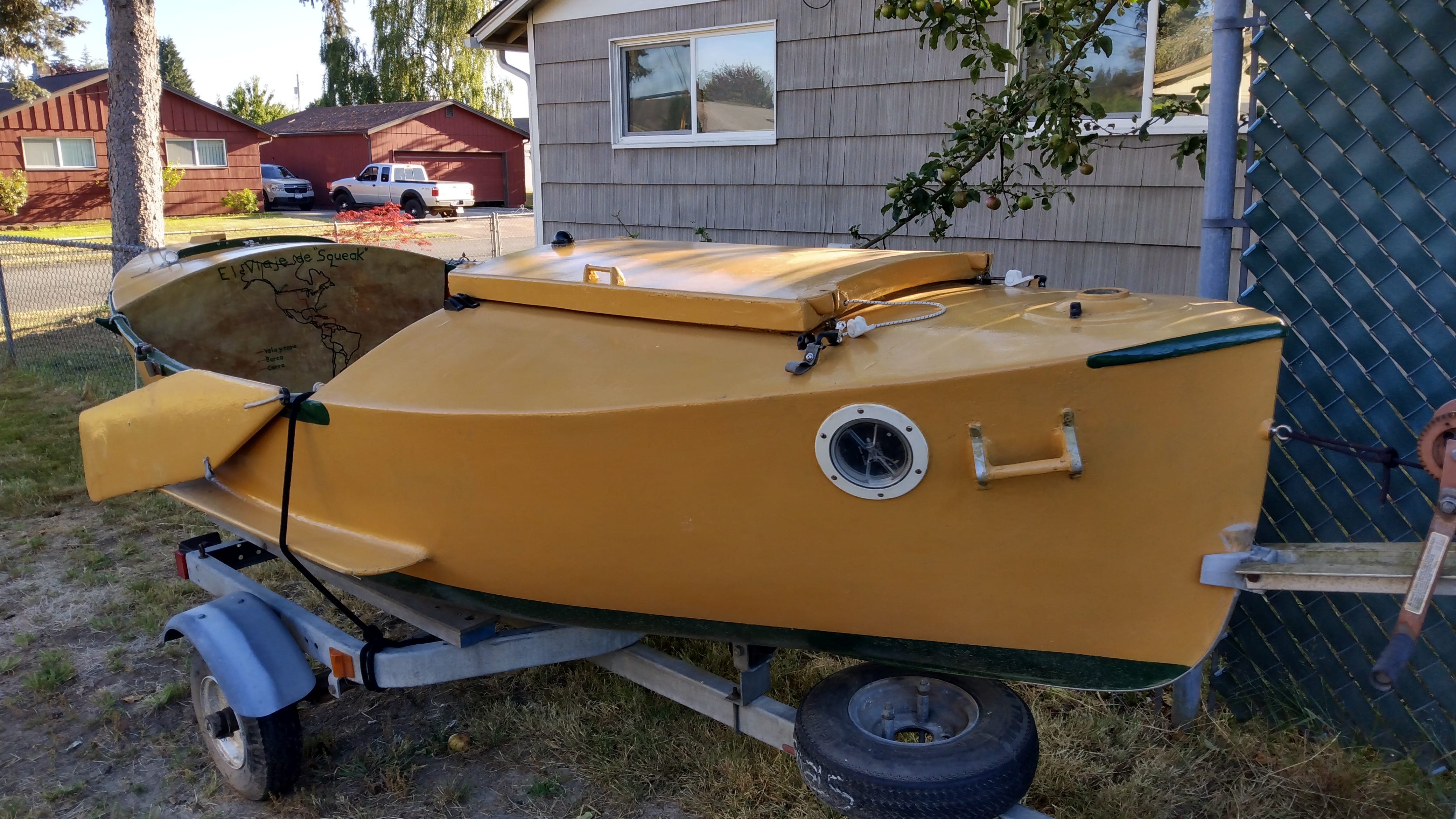
This brings us to the final and manliest duty of the deck: to support us while we “work the boat.” What a lovely phrase! A boat isn’t a car. You don’t sit inside and push buttons. A boat is a platform on which we venture forth. It supports the many manual tasks required of us. Some may be performed seated, like swinging the tiller, but others require standing or crouching: raising a sail, weighing anchor, tying up to a dock, or plucking our hat out of the water after we’ve lost it overboard then circled back around to retrieve it. In emergencies we need to quickly jump around doing this or that, juggling the several actions demanded of us. Sailing is physically demanding. People have tried to automate it, and failed.
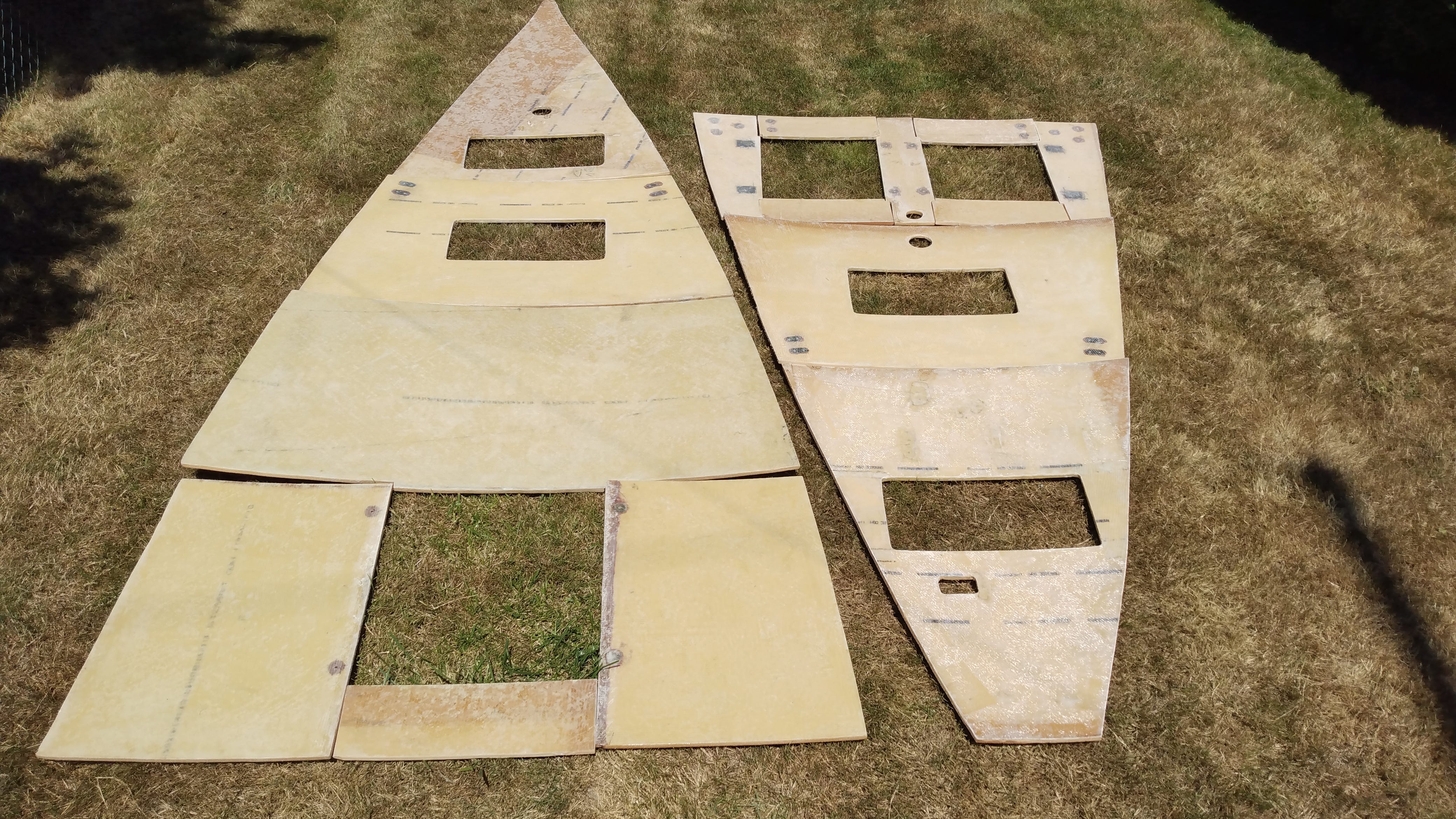
One sits a lot in a boat, and it’s fun hunching to windward, tiller in one hand, sheet in the other, studying sails, waves, and buoys. But at any moment you could have to secure a flapping sail, fend yourself off from a dock, or paddle through a tight space. Make the deck an inviting place for brusque activities! It should be moderately level fore-and-aft (not too much sheer) and side-to-side (not too much crown). It should be as free as possible from obstructions such as dinghies, ventilators, coamings, windlasses, shrouds that angle so as to block your path, or the thousand-and-one things that people leave laying around. Have compartments in which to stow your fenders. If you need them, and the boat isn‘t big enough to fit them inside, maybe your boat isn’t big enough. Keep that deck clear, clean, and open, and scamper about on it as necessary. Especially don’t station objects so as to block your view forward! Dodgers must be see-through.
And that about sums up the duties of a deck! May it perform its duties well, that we may perform ours. •SCA•
Find Steve’s book The Five-Year Voyage here.
See his recent article on hatches below:
