
Reader Boat: Clancy Trimaran
“Messing about in boats” is a well known saying in our hobby. I like using the term “with” instead of “in.” Here’s why: To some the saying means building boats, to some it means to modifying and experimenting with them, and to some it means spending time out on the water. To me it means all three! I found out years ago that I enjoyed building boats almost as much as sailing them. A few years later when I built a boat for a friend I realized I enjoyed the building process, even when the work was not for myself. That realization led to an early retirement and a new business venture. I play with boats every day now!
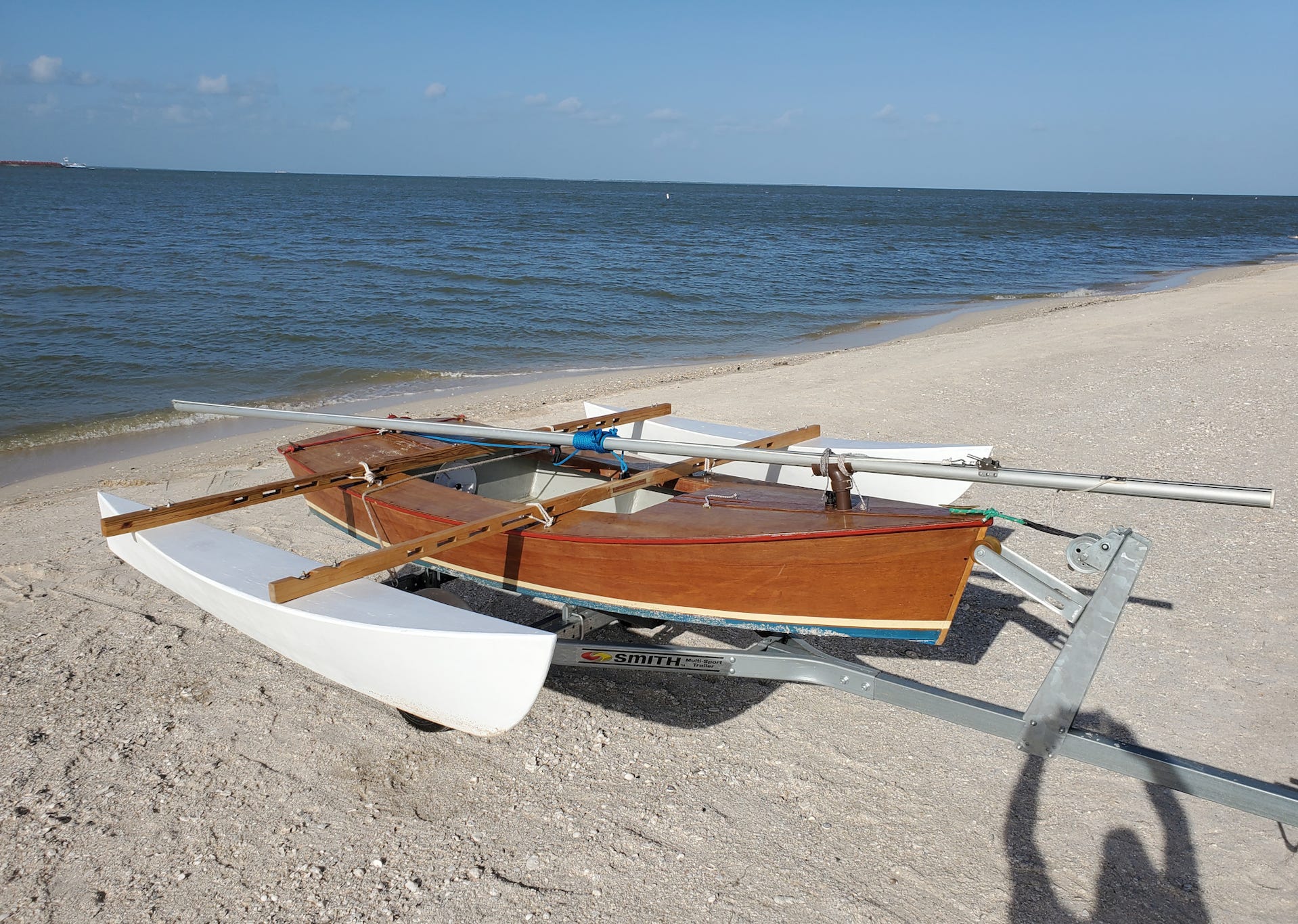
About a year ago I was visiting online with a friend, Ray Whitney, and he asked for some help finding a new home for a ten-foot Clancy dinghy he had built. I told him I’d try to help, but then he said I should take the boat. My first thought was, I have a full fleet already with my Princess 22 and a Saturday Night Special. But…..then it dawned on me that I did have a niche for this boat. My wife and I have a little getaway at Magnolia Beach, the finish line for the Texas 200. We typically spend a lot of time as beach bums down there. We enjoy spending the day relaxing along the shoreline and just being at the beach. I like to bring a small boat and push it off every now and then to sail back and forth along the shoreline. So, I accepted the offer and made the trip to Texarkana to retrieve the boat.
Ray did a meticulous job building her and she is a beauty. He is a master with rope work and it has a lot of really nice touches, such as an internal halyard in the mast. Also, the screw holes have been covered with wooden plugs, and the hull has a beautiful varnish finish.
When I picked her up, he warned me she was a bit tipsy. She is small and on my first sail the wind was light, so I didn’t really notice issues other than I had to sit down in the cockpit as my weight on the side deck would flip the boat over to windward. Sitting in the cockpit wasn’t bad until I had to tack—it was a contortionist’s challenge to swing my body around in such a small space!
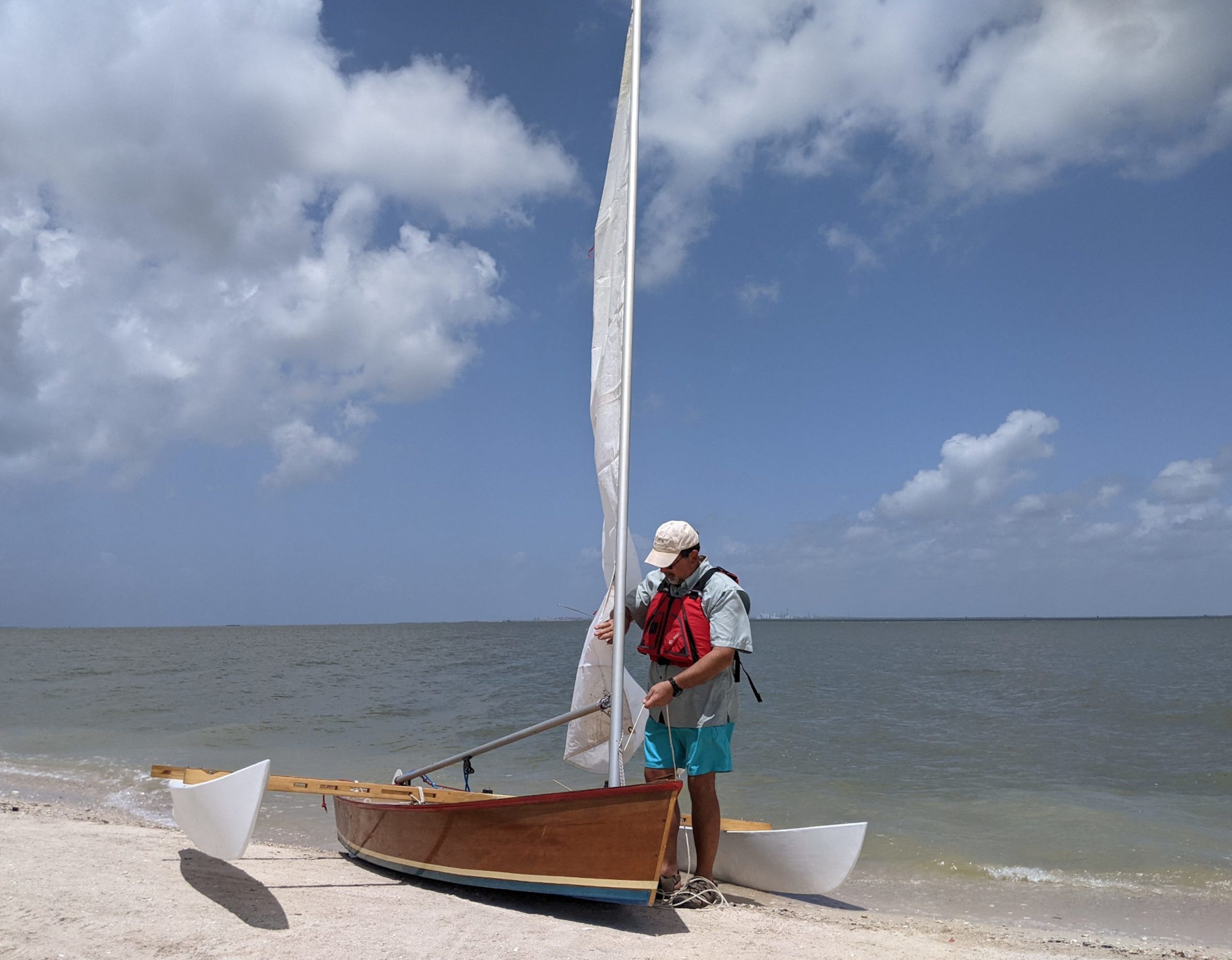
The next sail was in a nice 12-14 mph wind. I found in these conditions she performed nicely, but any more wind was going to be a problem, as I still couldn’t hike out on the side deck. A younger, more athletic sailor may have been able to, but I think those days are gone for me. There were a few near-capsizes that day, and Magnolia Beach is known for often having more wind than this.
I spent some time thinking about this issue, and a solution popped into my head. I went online to Duckworks.com and looked at Michael Storer’s “Drop-in-Outrigger” plans. The description sounded perfect for this application. I ordered the plans and downloaded them. Now, I just needed to find the time to build them. They are a simple build, but I was into the busy season for my little business of making rudders, daggerboards, and tillers for production boats. Spare time was at a premium and my wife was still insisting I cut the grass occasionally.
The Texas 200 came along and since I was running behind on some orders, I decided to not participate in the sailing. I did make myself available helping to ferry people back to their tow vehicles if they decided they needed to drop out, and made several trips up and down the beach late in the week. After the finish and the delicious barbecue meal, some of us decided to meet up at Bob and Lisa Rambo’s house for an “after party.” The Rambo’s are quite gracious, and their home has recently almost become the Texas 200 clubhouse.
While there, discussion of building boats, boating and seamanship were the primary topic. I mentioned my plan to build Storer’s outriggers for my Clancy and Paul Howard revealed he happened to have a pair he no longer needed. I was blown away and excited about the time this would save. I asked where he lived, wondering about the drive time to retrieve them, and he said they were in the back of his truck, parked outside. We made the transfer to my truck 10 minutes later.
I’ve been a member of the Texas 200 sailing club since it started in 2008, participating in the first seven, which formed a community of boaters. As we got to know each other on the bus ride a few of us realized that we were with other boat nerds and we’d finally found our people. Most of us have boats that live on trailers and get hauled all over the country to be sailed for a few days and then taken home. We have now been sharing information, and our lives, for several years—first on the Texas 200 website forum and then on Facebook, where we migrated a few years later. We all owe Chuck Leinweber a huge debt of gratitude for starting this event and community.
What amazes me the most about this group is their generosity. Boats are frequently changing hands with no exchange of money. Most are just glad to see a boat they have built or restored go to a good home and continue to be used instead of languishing on its trailer until it has to be disposed of. I’ve been the beneficiary of this and have also passed on a few boats. I tip my hat to Ray and Paul for their donations to what has become this whacky little project of my Mini-Tri.
In early August I took the outriggers back down to the coast. The Clancy was already living in the little garage I have there. Once there I installed the lashing hardware as described in the plans and mounted my amas to the Clancy. Presto! Instant trimaran! The combination is now a ten-foot-long boat with a 10-foot beam. I took her down to the water that afternoon and she is such a piece of cake to get in the water and ready to sail. I pushed off and sailed out into the bay. The primary concern I had in the back of my mind was…is she going to tack? With this much beam on such a small boat, I wasn’t sure. I sailed a Hobie 16 for years and occasionally would get stuck in irons. That taught me the magic of sailing backward and backwinding the sail to get the boat around and sailing again. I also learned that sometimes it was easier to gybe! So, I sailed out into the bay and headed upwind to get some distance from shore and the swimmers, with the intent of trying a tack as soon as possible. Once I was in the open, with good boat speed, I pushed the tiller over and she came around with no problem. That was great! Now I decided to just zip back and forth along the beach to see how much speed I could get and how she handled the swells. The wind was in the 15-18 mph range, so I was glad to have the outriggers. I was also glad that I could now sit on the side decks, or anywhere I wanted with no concern of flipping her over. I was also impressed that she showed no desire to put a hull under and capsize in a spectacular fashion. I even pushed it on a few downwind runs to see and she dipped her nose, but she always raised up over the swells—well at least the amas did!
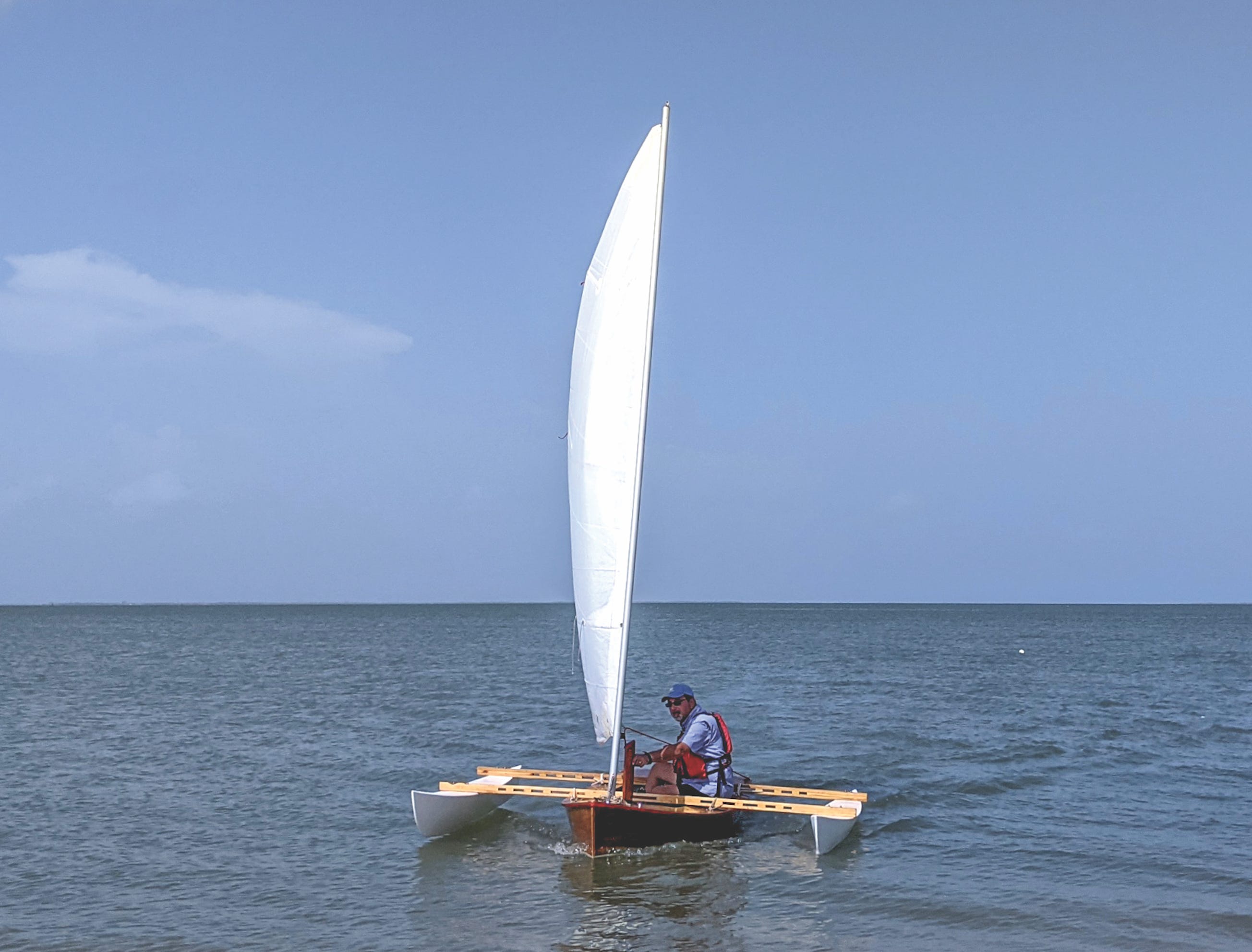
There were several times that I was able to get the boat up on a plane and moving quite well, maybe 10 knots. I am not sure because I was having some difficulty with the changes I had made to the mainsheet and I was dealing with a lot of weather helm, so both hands were too busy to try and get any GPS readings. I think, with the extra power you can have in the sails, without having to pinch up or spill wind from the sail to keep her standing up, that more weather helm is induced. I did have a few missed tacks later in the day and I decided that a new rudder was in order, not surprising as that is what I do, make rudders. One reason was to get rid of the weather helm and the other was to have a foil that won’t stall so easily.
The original Clancy rudder as designed is made from a metal plate. I built a nicely shaped foil for the rudder with the center of effort moved forward some. This will be mounted in a Holder 14-style cheek assembly that has a unique method of raising and lowering the board. A rod inside the cheeks connects between the tiller and the rudder, which has a “cam” shape at the top end. A quick snap of the tiller up will raise the rudder, holding it there, and a slower raising and lowering will drop it. A bungee is used to keep the tiller and the rudder blade down while sailing. I make a lot of these for Holder owners and wanted to try one on one of my boats.
I was back out recently and tested all of this. In about 12 mph winds she was sailing nicely. No weather helm, every tack was on a dime. I even retreated back into the cockpit to kick back and let my feet hang over the other side as I sailed along with no concerns about balancing the boat. I also never had to change position, perfect for an old guy! I zipped back and forth along the beach several times over the course of the day and felt she was pretty dialed in. The only downside: When I sailed out into more open water, the two foot waves washed over the deck and added some water to the cockpit. Not surprising as I am pretty sure that she was designed for more protected waters. Otherwise, she is a simple to launch boat that is a blast to sail and very stable. A perfect beach bum boat! www.bobbysboatworks.com •SCA•
First appeared in issue #132
I've always loved the idea of a similar project, but hesitated. My concern is not only potentially limiting my weatherliness under sail, but also ruling out alternate means of propulsion (no room to row or paddle). How do you maneuver if equipment or weather issues make it difficult to sail?
A coaming on the front deck wouldn't be difficult to add to keep the water out of the cockpit,, methinks. I liked the article, and it gave me some ideas for a build which I have procrastinated on for many years....
~Kees~