

For decades I’ve used the term “White Plastic Sloop” to describe the genus of production-built sailboats that were pumped out in feverish numbers from the 1960s until about 1990, when the wellspring of buyers ran dry. It’s not a kindly designation. Visit any marina and most of what you’ll find are underused White Plastic Sloops with oxidizing gelcoats.
I offer up the Gary Mull-designed Ranger 23 as proof that there are gems to be found amongst the rows of WPS’s mouldering on jackstands in the back lot at the marina—the kind now being cut up for the scrap value of their ballast keels.
I owned a 1974 example, which I bought for $1500 shortly after college. Sailing in Chesapeake waters in the mouth of the Chester River—a spot that’s uncommonly windy and rough–I came to love the boat’s handling under sail and its many thoughtful details. It may have been a WPS, but it had some special sauce.
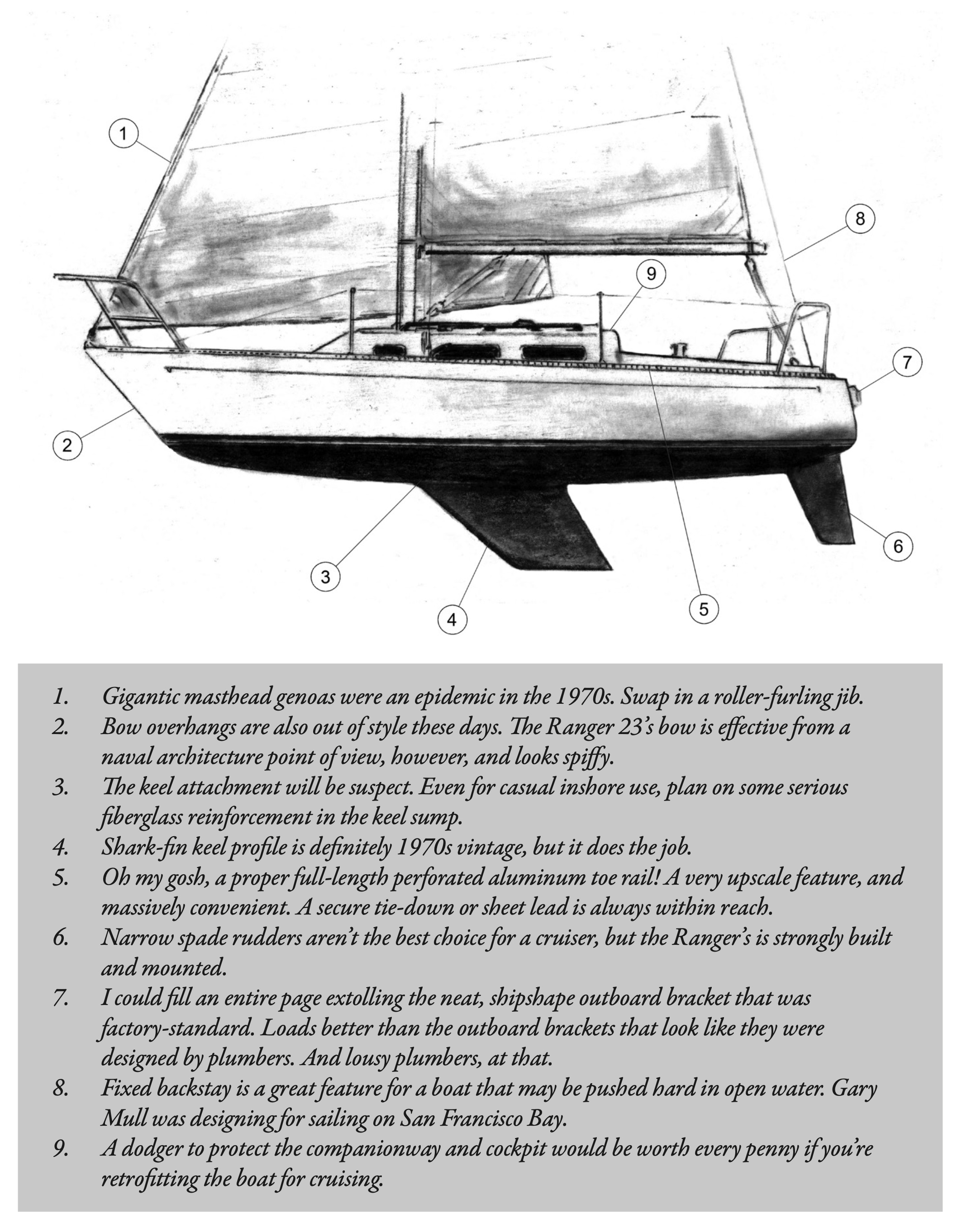
At the dock, a critical eye will soon pick out subtle refinements in the Ranger 23’s proportions, absent in so many of its mass-produced 1970’s competitors. The rakish bow and understated transom compliment the almost-straight sheer. The coach is just the right height, with wide side decks for real-world sail handling. The cockpit and interior are just right. There’s no clutter; the spaces are open and relaxing. Gary Mull remarked, “We didn’t feel compelled to offer standing headroom, as we were fairly certain that the owners were smart enough to sleep lying down.”
The preferred tall-rig/deep-keel option gives you a masthead rig with a sturdy 30-foot mast. As a budding boat designer, I marveled at the 23’s stiffness and balance under sail. Most of that is thanks to the lead keel, which comprises 44% of the displacement. It’s also the fair, balanced lines below the waterline that distinguish the Ranger from its porcine, hard-mouthed cruiser-racer contemporaries.
Gary Mull designed the Ranger 23 in 1971. A wunderkind who seems never to have drawn a lousy boat, Mull’s design brief was ambitious. The 23 was meant to race in the MORC class, which it did with success. But Mull also stated he wanted “a little ship capable of sailing anywhere in the world safely, and swiftly.”
Really! Well, let’s ponder that scenario. I’ve seen videos of Ranger 23’s surfing under perfect control in huge Pacific swells. So the handling is there, as is the quality of construction—hand-laid roving and mat, no chopper gun here. The interior layout will work offshore if you don’t mind a wet sleeping bag.
So, having tracked down a neglected, rainwater-filled Ranger 23, you’ve got the bones of a great pocket cruiser. You’ll need to replace the main bulkhead, which will have rotted from leaks around the chainplates. The attachment of the fin keel to the hull gets mushy with age. (I sold mine when that repair job loomed.) Add a canvas dodger to shelter the cockpit, a furling jib, a solar panel, and an autohelm, and cautious offshore crossings are within reach. I kind of wish I’d upgraded my cheap Ranger 23 and sailed south until the butter melted.. •SCA•
The Ranger 23 was one of the really good, affordable designs of the type and period, along with the Catalina 22.
I bought a Cape Dory Alberg Typhoon.😀
In the UK we calle them AWB's - Average White Boats
Some years ago I wrote a little poem about them:
AWB
If the Average White Boat gets your goat
Help is soon to hand.
A can of spray paint’s just the thing
To make it look less bland.
Pink or green or red or gold.
Rescue orange looks rather bold.
Slap it on quite merrily.
(Just don’t let the owner see.)