
Presenting the Amazing Pedyuloh
Facing Forward, Pedaling an Efficient Yuloh (!)
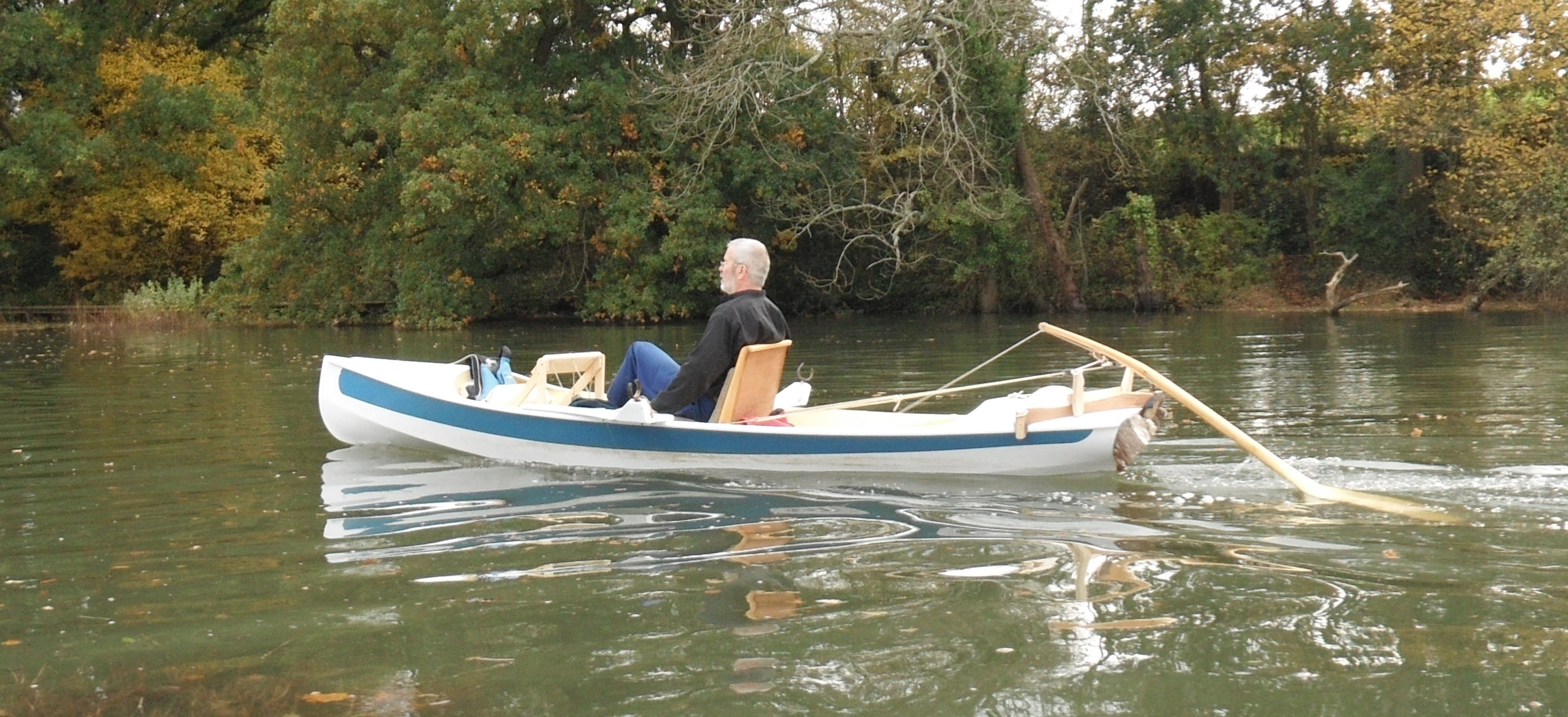
by Chris Waite
The problem with rowing is that you only get to admire where you’ve been, not where you’re going and especially if your neck is like mine. A quick glance over the shoulder may give you a notion of what’s coming next but it doesn’t paint the full picture.
Years ago I took part in the annual Home Built Boat Rally’s Thames Raid from Lechlade to Beale Park—some sixty miles, camping over five days. The first year, I had made a sixteen-foot rowing skiff (pictured above, in the pre-yuloh days), and rapidly found that the tortuous upper reaches of the river—all bends and bushes—were no place to be maintaining a blind, record-breaking dash. After I narrowly avoided creating a five-knot furrow in part of Oxfordshire (a chap nearby roared “BANK!” at the crucial moment), it started to dawn on me that I needed to see where I was going.
First of all, there were experiments with mirrors; I first tried one lashed to a stalk on a headband above and outboard of one eye.
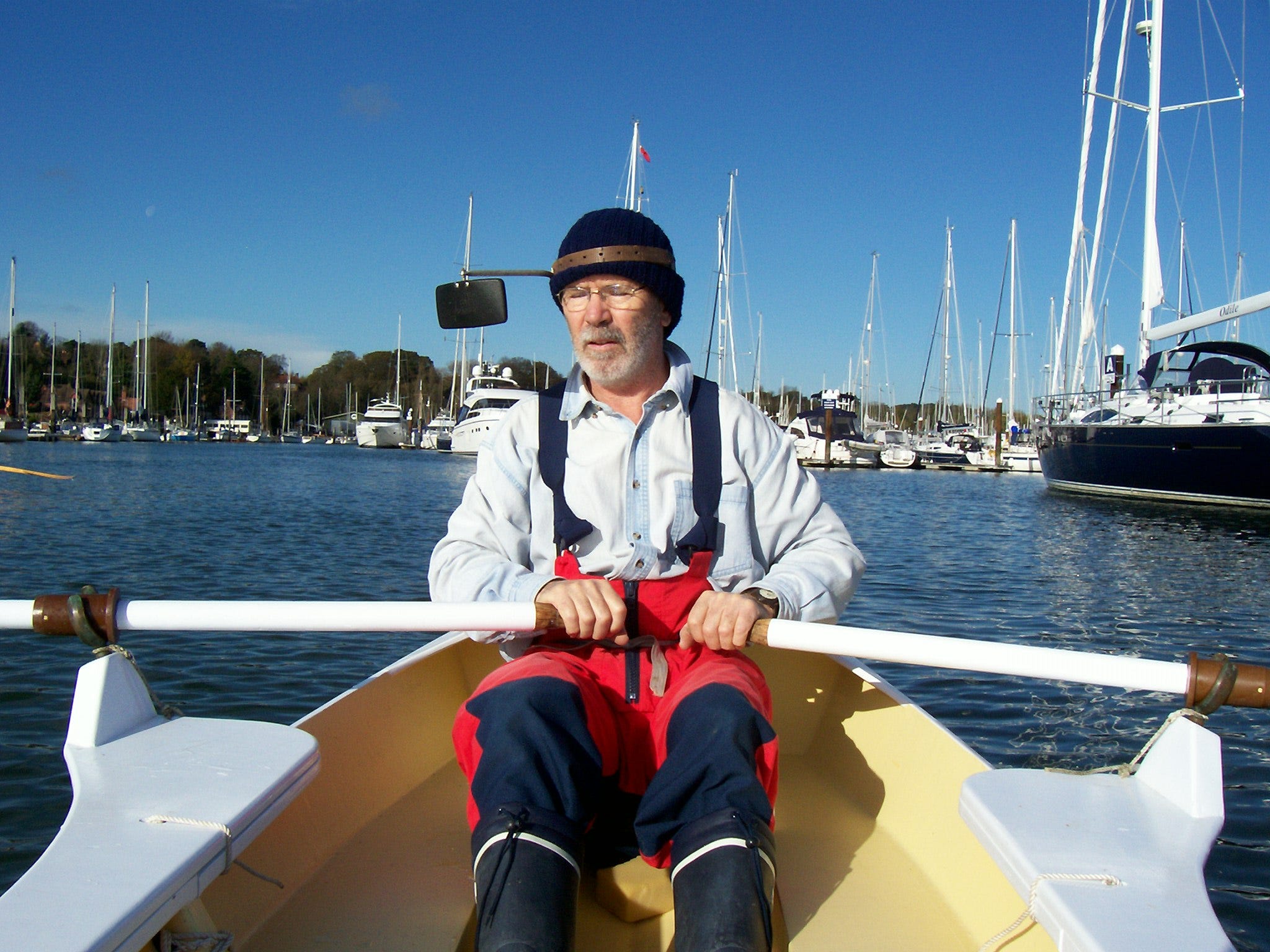
Above - Early failed experiment with headband-mounted mirror.
The small rear-view mirror proved useless. The instinct is to turn toward what you see coming, but being a reflection, this simply causes it to disappear and age-related discombobulation means you’re never going to learn the new trick of turning your head away from the threat. Next, I mounted a bigger rear-view mirror on a pole clamped to the gunwale. Better, but I found myself still needing to concentrate so hard on the limited reflection, that I really didn’t appreciate much of the next trip at all. It also fell into the river after one long day and if anyone wants it, it’s on the bottom, somewhere downstream of Wallingford bridge.
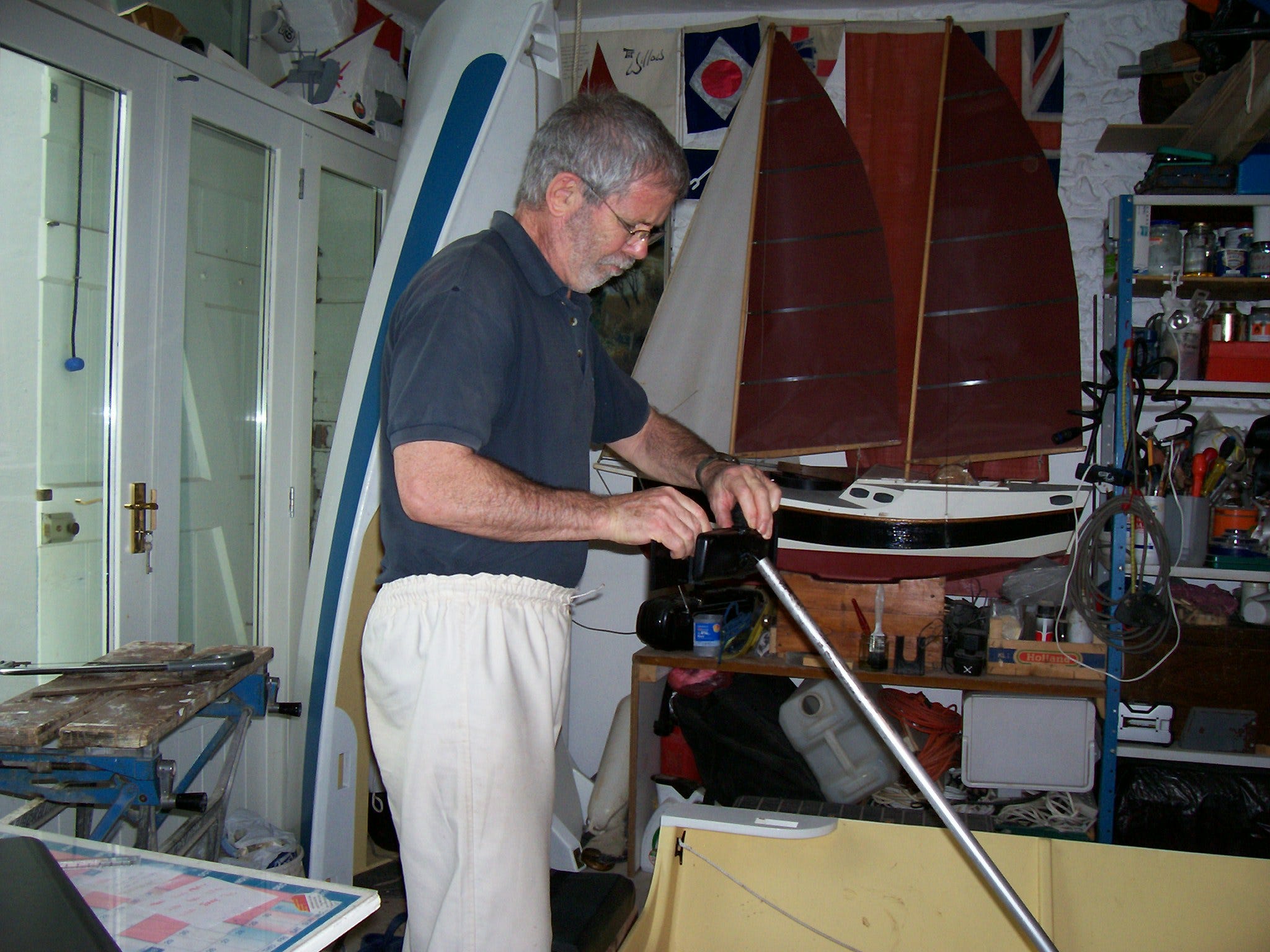
Above - In the garage, fiddling with a mirror attached to an alloy pipe.
No; to absorb the full beauty of the surroundings, you have to face forward.
One of our number bought a Hobie Mirage Drive, successfully mounting it on multiple vessels now, but it requires a large hole in your boat and an even larger one in your wallet.
Another small-boating friend came up with multi-levered oars that work backwards while you face forward—effective, but too complicated for my rudimentary metal workmanship.
What to do? Well, I scratched around in the cobwebbed canyons of my mind and came upon the Oriental form of sculling over the stern—the yuloh. This is that amazing form of propulsion, the blade working flat, across the flow, but with all the problems ironed out. There are two main difficulties and they’re both solved with devilish cunning; firstly the pressure on a sculling blade causes it to try and dive under the boat. A tether on the handle, linked to a central eye somewhere forward and below handle level eliminates this problem.
The next is that the oar needs ‘cocking’ to an angle that encourages forward motion. If the scull loom forward of the notch (or rowlock), is bent slightly downward, then it naturally wants to rotate to a suitable angle of attack.
The yuloh has been propelling boats forever in China, where the device was perfected. It makes you wonder why us smarty-pants Caucasians couldn’t work it out for ourselves, doesn’t it?
The yuloh may be as simple as it sounds, but as I found the devil is in the detail. (Seems it was Thomas Edison who said, “I have not failed, I have just found ten thousand ways that won’t work”.)
I second that.
As I am unable to make heads nor tails of Chinese characters, I spent considerable time working out the following:
1. The bend in the loom should be inboard of the rowlock or pivot and, a smidgen will do since it is, after all, only a crank to alter the angle of the blade. Excess merely exaggerates the action and locus of the blade and is therefore a waste of good stroke.
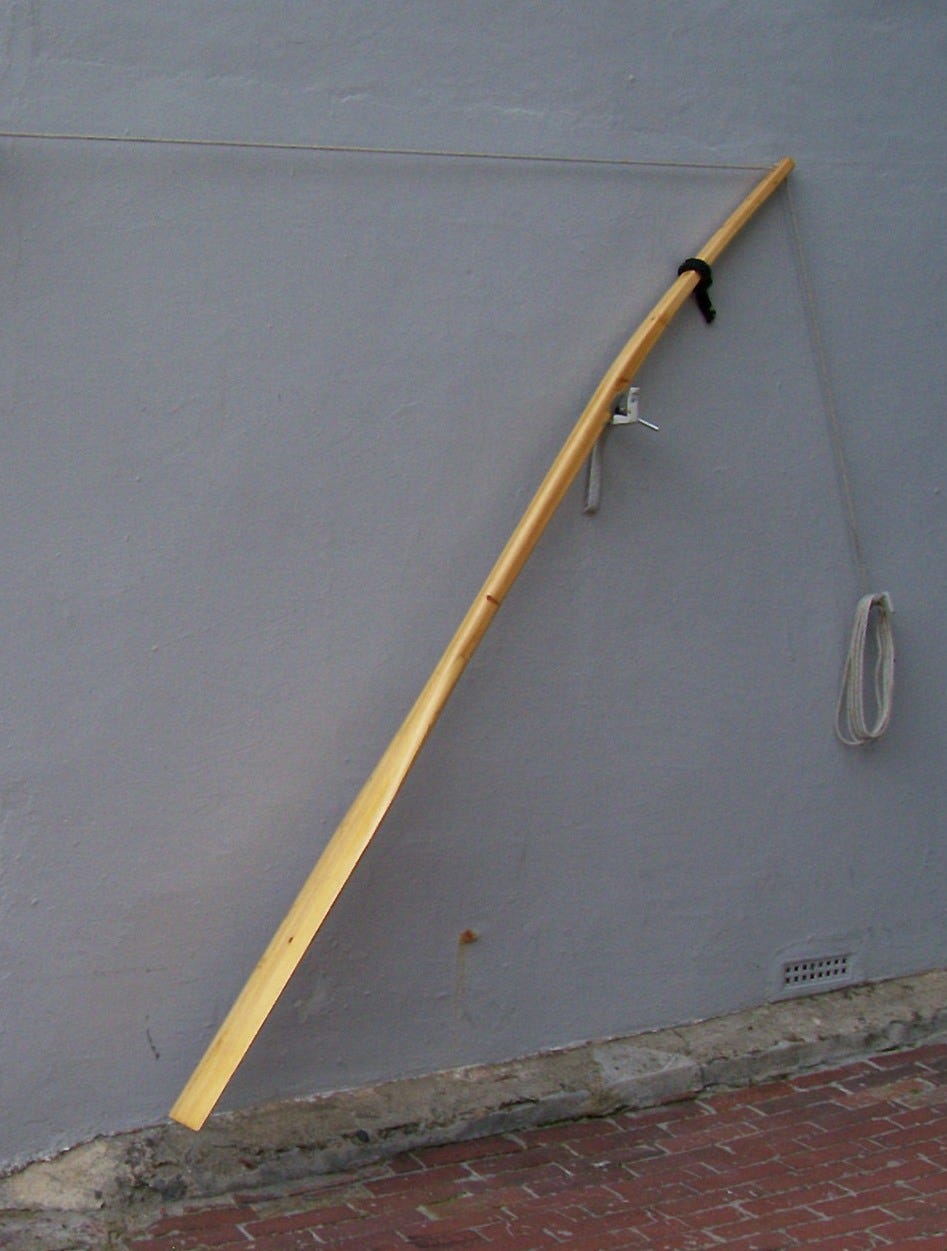
Above - My second yuloh attempt. The first was beautiful in contrasting laminations, but it had too much curve, and in the wrong place.
The handle of the above yuloh was partially amputated for trying to poke me in the back, so it now measures:
LOA - 2150 mm (85 inches). Blade - 500 mm x 135 mm (20 x 5.3 inches).
Handle to Pivot - 525 mm (21 inches). Handle Offset (bend) – 55 mm (2.1 inches).
2. To encourage the yuloh to self-cock, rather than a rowlock, it appears to traditionally be mounted on a small rod, possibly ending in a ball, within a recess in the underside of the loom (shaft) of the yuloh itself. This makes the arrangement unstable so it prefers being cocked to ‘feathered’.
3. The angle of ‘cock’ seems to work best at around forty-five degrees each side of flat. This should depend on the speed of the stroke relative to the hull speed. I have based the yuloh on an eight foot oar being neither a complete shorty, nor inordinately oversize and has worked well on hulls from ten to sixteen feet.
4. The angle of dangle doesn’t get better the deeper the blade—almost the opposite and certainly no deeper than thirty degrees. I have to say this one is beyond me; I cannot decipher any good reason why a blade working at a shallow angle should be more effective than a deeper one, but it definitely is.
5. It seems to work with no more than a quarter of the shaft inboard of the pivot—pretty much like a normal oar. (Bear in mind that this refers to a leg-driven system with more muscle than is to be found in the arms.)
“But what about the facing forward?” I hear you cry.
Well, that’s really what this article is about, but it helps to have the above points already in your head. I have stumpy little sailor’s legs and it occurred to me that though thus limited, such limbs are designed to go the distance. And they could surely do with the exercise. So there I am sitting comfortably, facing forward, and there is the yuloh behind me, anxious for my bidding. Once I had it in mind, I looked it up on the Internet – some guys over there in the USA were discussing it and they agreed to go away and see what they could come up with…but there the trail went dead. No matter, the yuloh is so well tamed there is no skill; the only thing you really need to do is wiggle it to and fro….
With your legs?
Yes, actually; the handle works from side to side, but if you fix turning blocks (pulleys) in each quarter—that is each side of the transom—you can run lines from the handle, through these blocks forward to foot pedals. Mine were and remain simple stirrups, hung from a deck beam or frame (though I have other ideas; not required on Polly Wee).
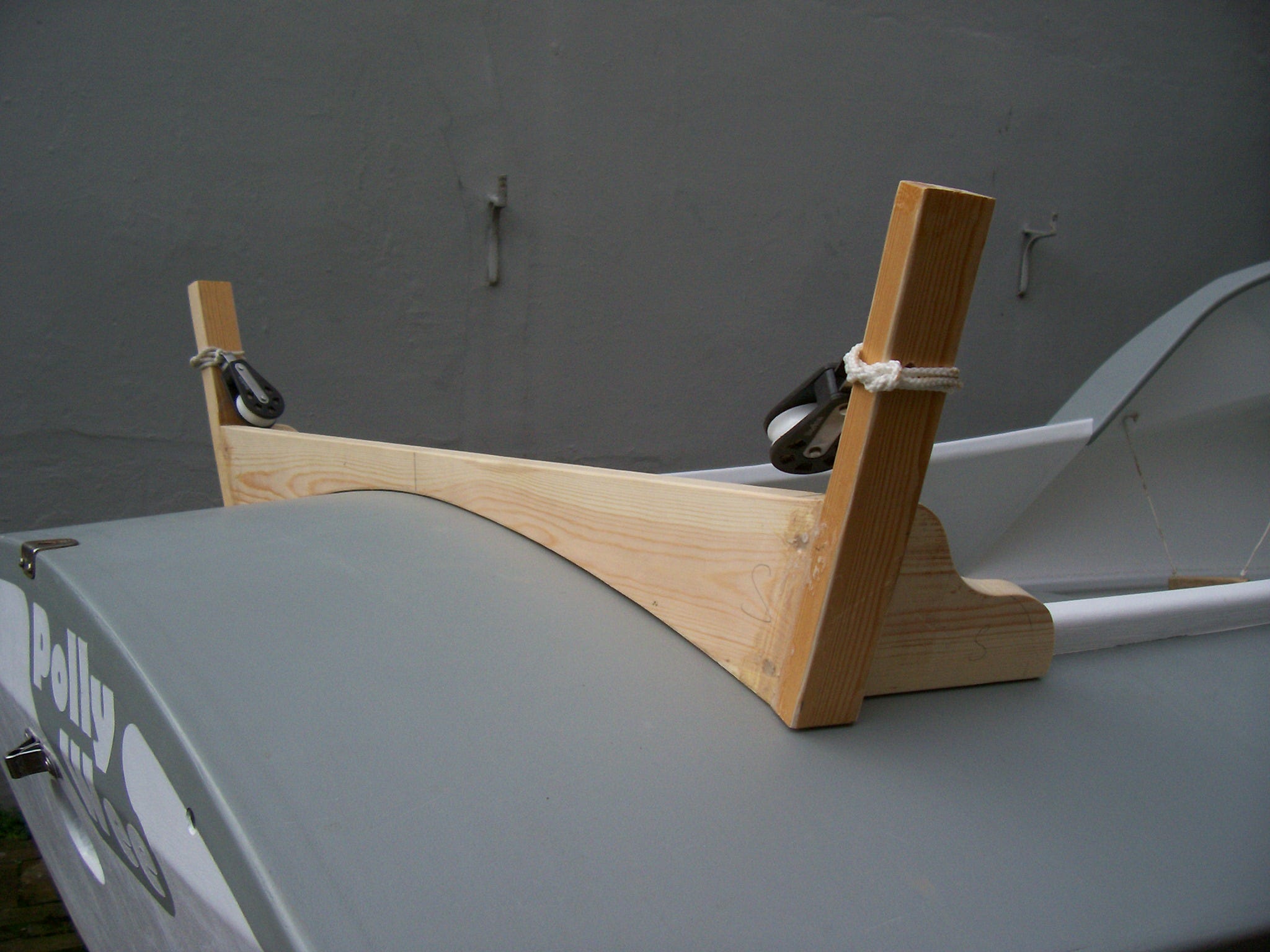
Above - The stern of Polly Wee with wood frame and yuloh-turning blocks.
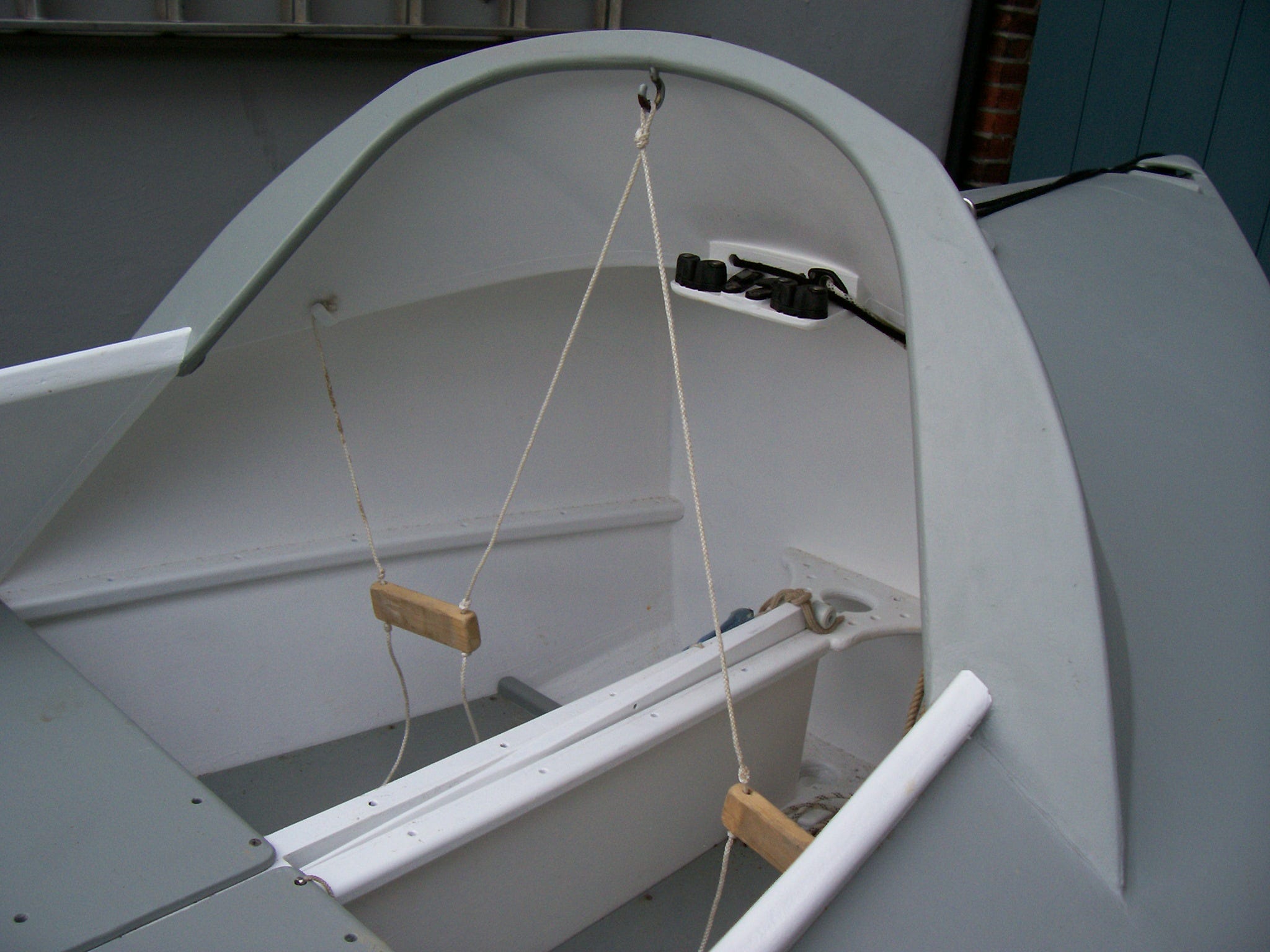
Above - Wooden stirrup pedals hanging from Polly Wee’s cudulette.
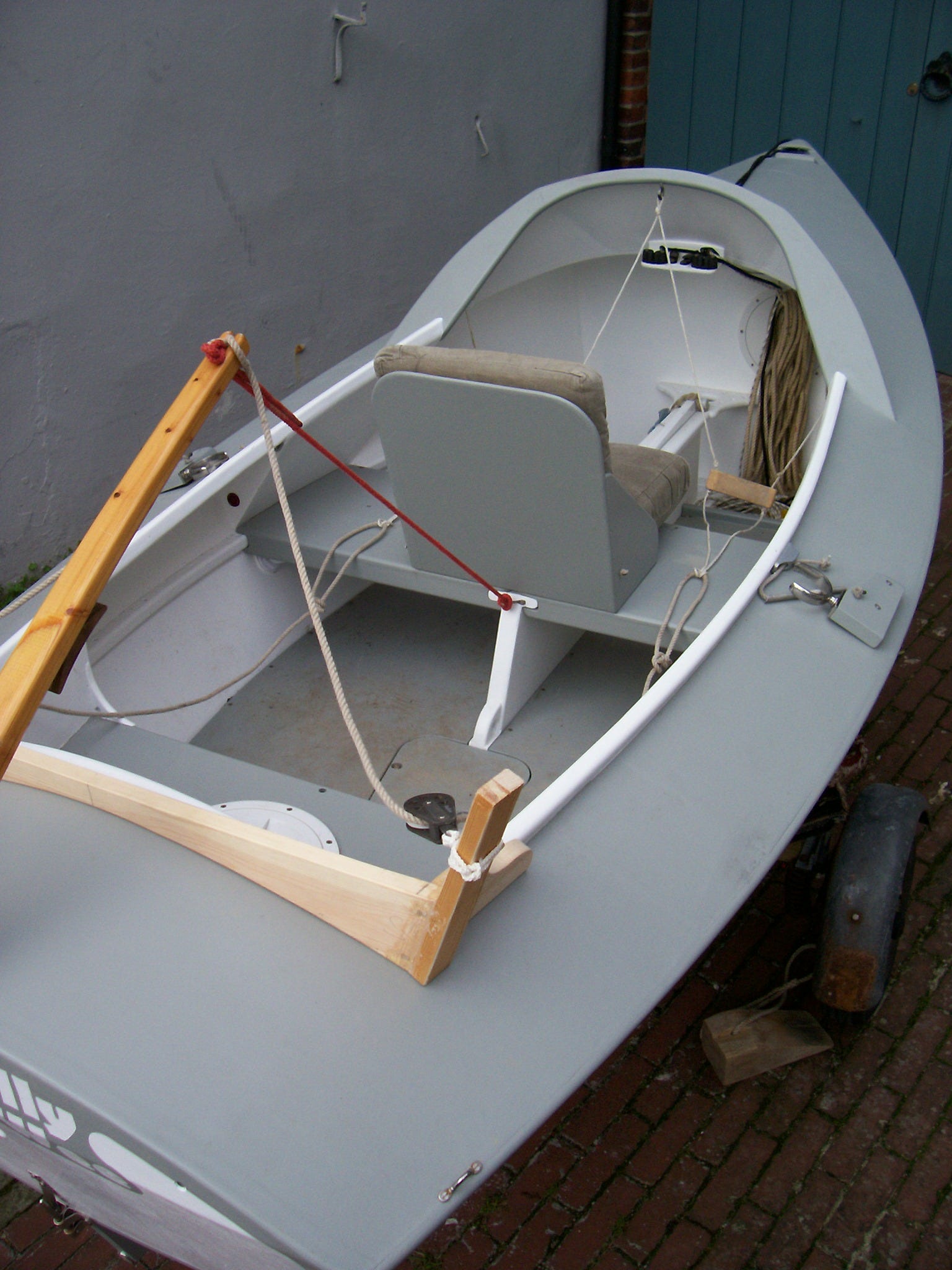
Above - Cockpit with yuloh handle, frame, turning blocks, seat and lines to the pedals.
Above - Here the author is shown pedaling the yuloh on Polly Wee, in a video shot by his friend Graham Neil. It worked quite well.
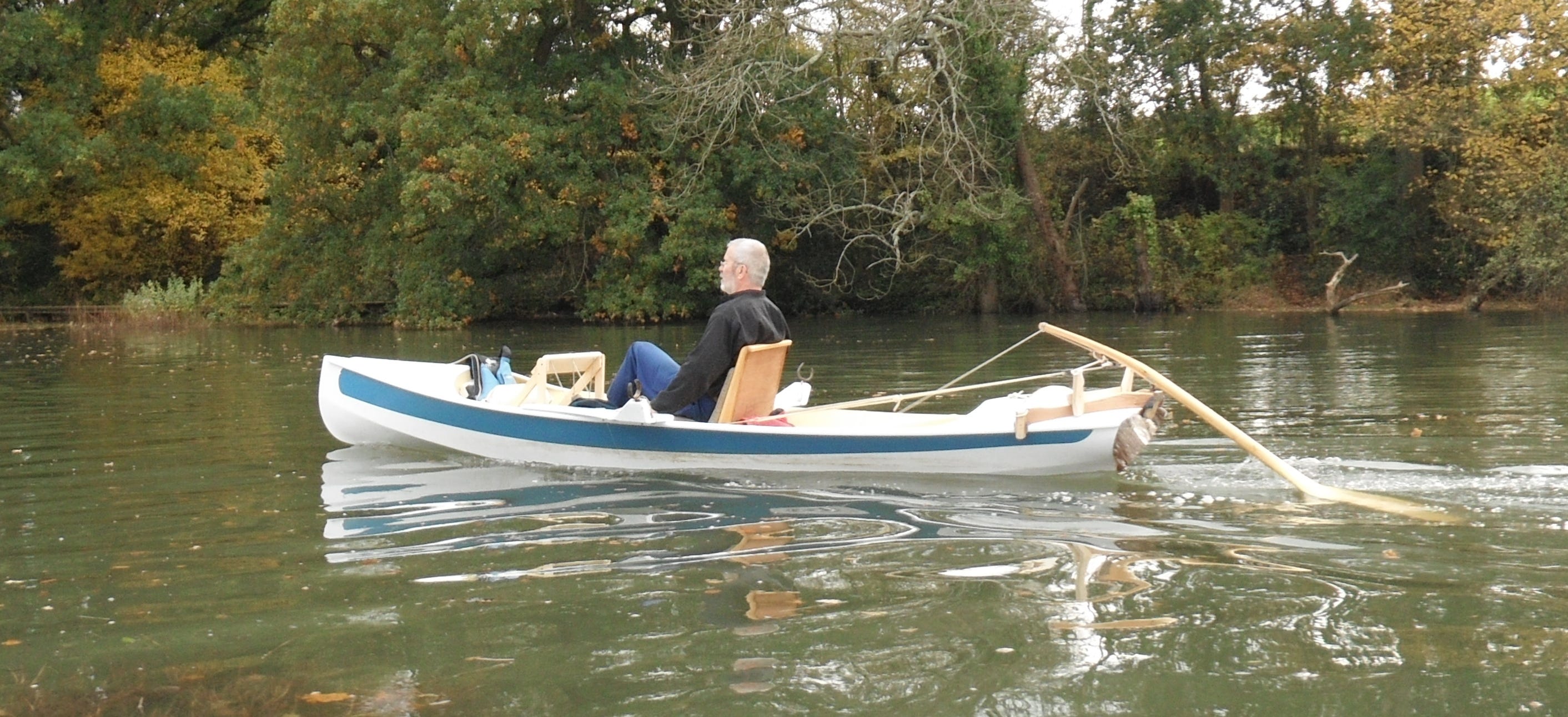
Above - The author also tried the pedaling yuloh on the original skiff he built for the early Thames River event.
It sounds and looks somewhat bizarre, but it works like a dream; among other shorter outings I’ve been down the Thames under yuloh many times now to prove it.
Here are some more tips: It is just about possible to steer by kicking harder and deeper with the outside foot of the turn, but my dinghy specifically has a through transom tiller so the yuloh can be mounted over the rudder. This provides much better directional ability.
As it is not easy to keep the yuloh on its pivot and at forty-five degrees each way while you are up ahead taking in the view, it really needs to be captive. I found this out the hard way, too, and first tried to lash it down with halyard wire (most of the strands gave way on just one short outing). Finally, I had a friend weld a ‘D’ shackle over the top of the unthreaded shaft of a stainless bolt. I cut a groove into the underside of the yuloh shaft, lined it with stainless sheet which provides a rather noisy forty-five degree stop each side, then screwed the D-hoop loosely into the shaft with a stainless coach screw. It has been good as gold for the last half decade.
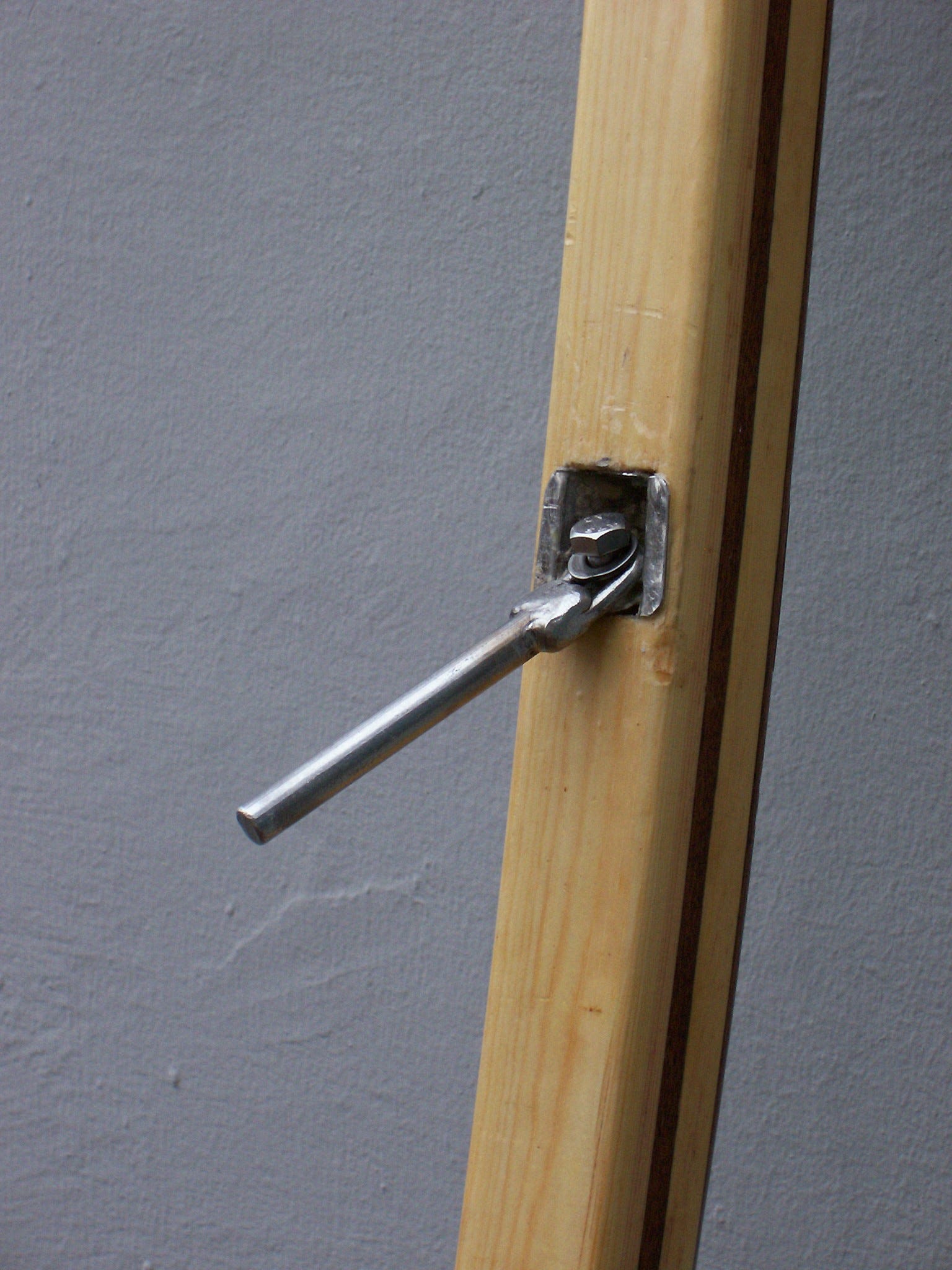
Above - Close-up of the pivot under the yuloh handle
It’s cheap, too, at perhaps a tenth the price of a Hobie Mirage Drive and unlike those, it doesn’t pick up weed. It pushes my little, raid-laden, single-hander along at around two to three knots all day, on an eleven-foot LWL. It does better on the lighter longer hull of course and can produce reasonable short bursts of speed.
Other pointers include a warning: like sailing, there are no brakes and I keep a single- blade paddle on hand for such moments. The noise produced by pedaling the yuloh can be ameliorated by tying a piece of bungee into the system—I slung one over the forward, lower end of the tether where it takes the bump out of the tether when it snaps taut as each stroke bites. I think it would do just as well tied into the length of the tether itself. This system does not have the flexibility of using your hands and I suspect the tether would cause it to rapidly cease to function in a seaway, the blade being alternately out of and well under the water, swell by swell.
Lastly I reckon to mount it on the rudder stock where hopefully it will oppose the somewhat vacillatory course it otherwise tends to induce. It may also reduce the amplifying effect of the transom or stern deck, which appear to act like a sound box; and will be tried on my next build—a river-raid, camping skiff.
And what is this marvel of sticks and string called? Well my chum Phil Oxborrow suggested a ‘Pedyuloh’ and that’s what it has become; a label somewhere between rather clever and deliciously naff. •SCA•
I can testify that the pedyuloh works extremely well. It's difficult to keep up with him when he puts his feet down.
Looks like a genius idea, and great execution! Amazing.