
Jinxed
Article by Jonathan Lewis
On the ultimate evening of our week aboard, we remarked how perfect our experience had been. The weather was flawless, the breeze never left us wanting, we had secluded anchorages all to ourselves, and even the sea nettles had disappeared allowing us to take dips in the bay. Besides motoring from the launch ramp at the start of our adventure, the electric Torqeedo Cruise 2.0 had been tucked away in its motor well. The access doors to the water had been closed, providing a fair hull for our time spent under sail. The agility of the cat ketch allows us to anchor and depart under sail in almost all conditions and our 2-foot draft with the centerboard up reduces anxiety in skinny shoal waters. My WindHub weather app was forecasting a calm for the next morning so the plan for the following day was to engage the motor to cross the St. George Creek and then again to approach the Piney Point launch ramp, a distance just over two miles.
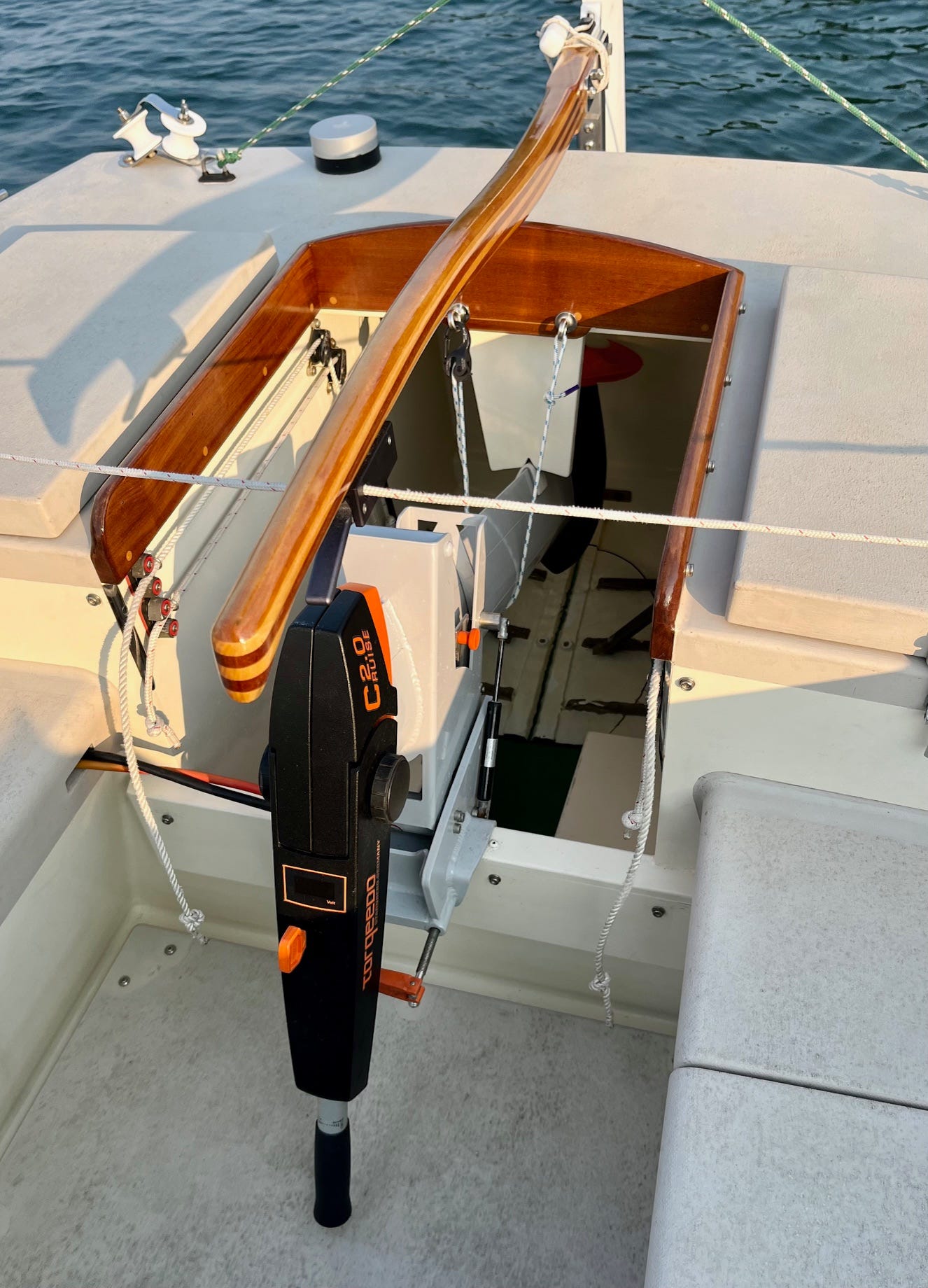
I removed the canvas cover and pulled on a couple of lines that ran through blocks and opened the articulating hull panels. This process always brought to mind the clever contraptions that the mythical “Q” developed for 007, AKA James Bond. I completed the motor’s immersion routine and while the small screen indicated 26.2 volts, I gave the tiller control a twist, only to witness the screen go black and hear a small whine of displeasure produced by my promise of propulsion. This wasn’t good.
I tried turning off and on the battery switch which connected the motor to the four six volt 220 amp hour AGMs in series. The display illuminated once again and my attempt to spin the bright orange propeller failed. With the power off, I reached down and turned the prop by hand. It moved begrudgingly but did manage to inspire a trickle of blood from a newly sliced finger. After several attempts and further investigation, I came to the sad conclusion that my barely-used 2008 motor was not going to operate, with water penetration into the lower unit the likely culprit. I would later read that O-ring changes by an authorized service center are recommended every six years on this model. My rinse it and forget it methodology isn’t the preferred maintenance regime.
Time to hoist the sails! It’s a sailboat after all and we’re self-sufficient mariners. With barely a breeze visible, we hauled up the anchor and tacked our way at a snail’s pace to a spot off our home. We went ashore and I moved the truck and trailer to the launch ramp parking lot. I rode my bicycle back to the house and we paddled out to the boat in our Alpacka Raft. Once again sails and anchor were raised but this time we kept the dinghy in tow, planning to use her if necessary. By now the wind had picked up and as we neared the launch bay, the direction was behind us and not optimal for depowering the sails as we approached the unforgiving concrete ramp. A complicating factor was the proximity of the low bridge to the island. To add yet another hazard, current runs under the bridge, exchanging water between the Potomac River and St. George Creek. The thought of battling wind, tide and current in such a shallow and restricted area with a couple of paddles wasn’t confidence inspiring.
In my “younger” days, I used to sail day charters to the Buck Island National Park off St. Croix. I didn’t have a Coast Guard license so I couldn’t have an engine of any kind. I’d sail through the cut in the reef and then approach the obligatory mooring field. I’d choose my target ball and go for it, luffing up into the wind and running barefoot to the bow to ensnare the pennant with my trusty hook. Failure could have resulted with the boat hitting the reef and my paying passengers sorely disappointed. It always worked.
I had a plan. I’d round up into the wind as close to the ramp as possible, trying to clear the current. I’d drop the Rocna and sails. I took the long line I’d made fast on the bow cleat and got in the packraft. I quickly paddled to the dock between the two ramps and started pulling as Betsy rapidly hauled in the rode. Once the anchor released its grip on the mud bottom, the bow swung towards me and I bullied the boat safely along side as Betsy fended off. The Townsend Tern now sat politely in the slip, awaiting the trailer to extricate her from the tributary to the Chesapeake, after an almost exemplary excursion.
At this point you may be expecting the “what I did wrong and what I did right” section that regularly appears in some publications. I’ll spare you the self-analysis. However, you may want to reconsider lifting a glass for a cocktail hour toast to a perfect cruise on the last night. Prudence suggests saving that self-congratulatory ritual for when you’re safely ensconced in your favorite chair, libation in hand, rather than tempting fate too soon. And yes, I’m researching new electronic motors. •SCA•
Oh, I loved this article. With the nickname "World's Worst Sailor", I identify with each and every problem experienced by fellow sailors because it has also happened to me. Captain Lewis handled the situation far, far better than I could. I would have ended up eventually in the Atlantic or the Basin in front of the Jefferson Memorial.
Jonathan, is this the very same Townsend Tern here in this article, link below, as it also had four 6 volt 220 AH batteries powering a Torqeedo, each AGM battery weighing about 60 lbs - https://smallboatsmonthly.com/article/townsend-tern/ Hoping your research for a new motor will reduce the total weight of your Tern's electric motor/battery system considerably. Thanks for the story - love the account of the final pull out, utilizing bicycle, oars, dinghy and line. Smart and got the job done nicely!