
Ken Fry sent us the following fascinating video. In his words:
This video describes how the wing on Wing and a Pair works. It shows how it is very much like an airplane wing, and provides the details on airfoil type, the function of flaps and slats, and how the wing’s lift is generated and controlled.
The boat does not rely on a computer. All control is accomplished by moving two levers in the boat’s cockpit, which mechanically move the control surfaces.
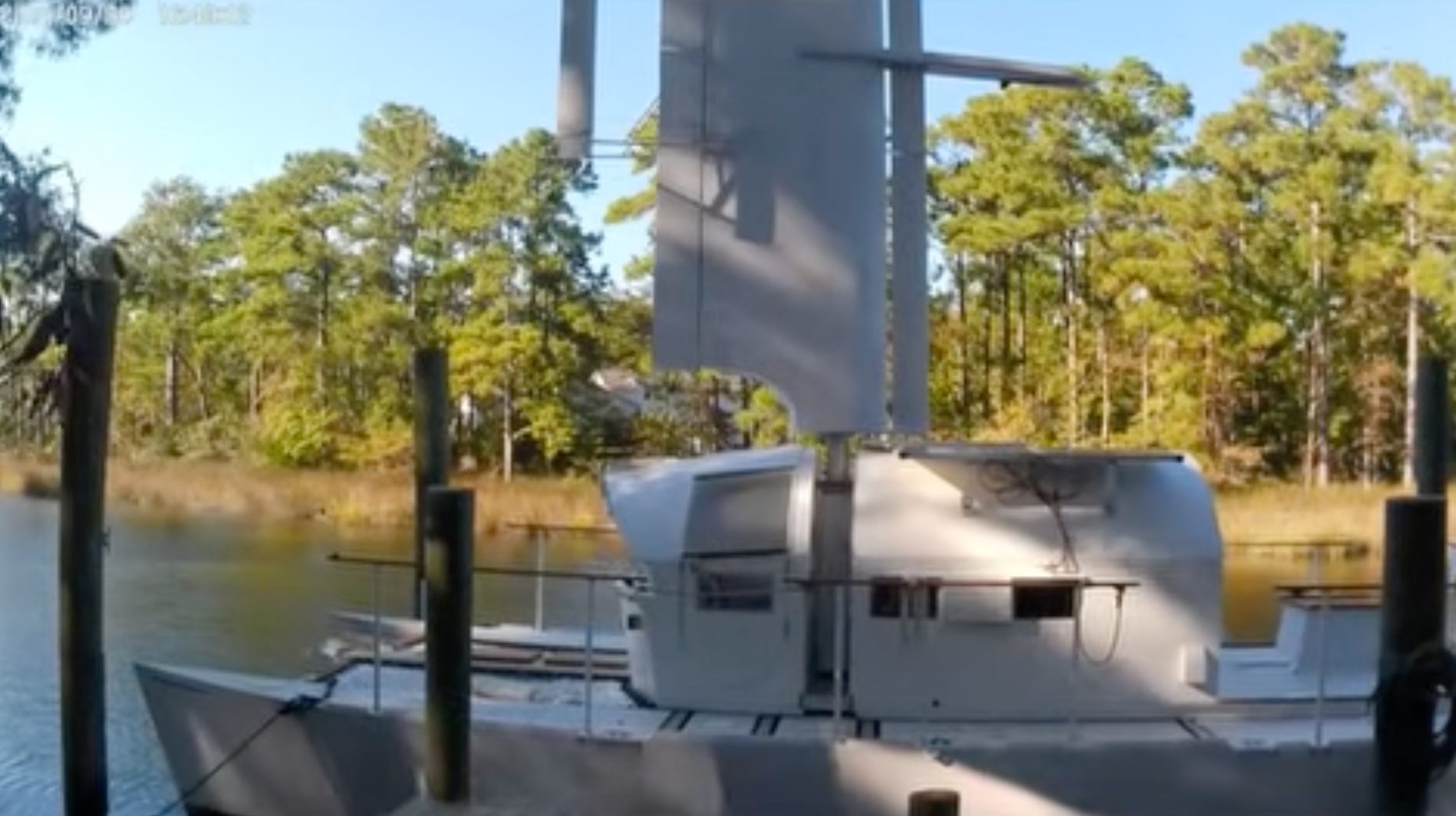
Magnificent explanation.
My desire is a bit simpler and my wingsails have been based on Peter Worsley's simply elegant circular cam mechanism. Having one simple lever that controls which way you go fits well with my obsession with proas ;-)
Ken Fry's setup is a bit more complex but more versatile over a wider wind speed, I wish him well.
For years, I have been contemplating a wing sail. My confounding issue is that I sail small monohull boats. That means that the boats are unballasted and lack the inherent stability of larger multihulls and monohulls. My solution, which I have never built, draws some of its inspiration from Chinese balanced lug concepts.
The removable mast is still enclosed within the sail. The sail is shaped by a series of airfoil shaped ribs, with hoops incorporated into the ribs. This means that the ensemble has to be assembled to the mast before rigging for the day. The halliard can be designed either internally or externally to the mast.
Reefing is accomplished with tack lines attached to the hoops and clew lines attached to the tail end of the ribs. If the ribs are closely spaced and some sort of boom is used, there should be no need of reef points as the ribs should flake the sail nicely at whatever reef level the sail is set up with. There is no need for more than one clew line, as it resolves to the boom. A light line can be passed through the reefed clews for neatness.