
HIDEAWAY, Part 5: Questions & Answers
Familiar Questions to Owners of Electric Boats: How Fast and How Far?
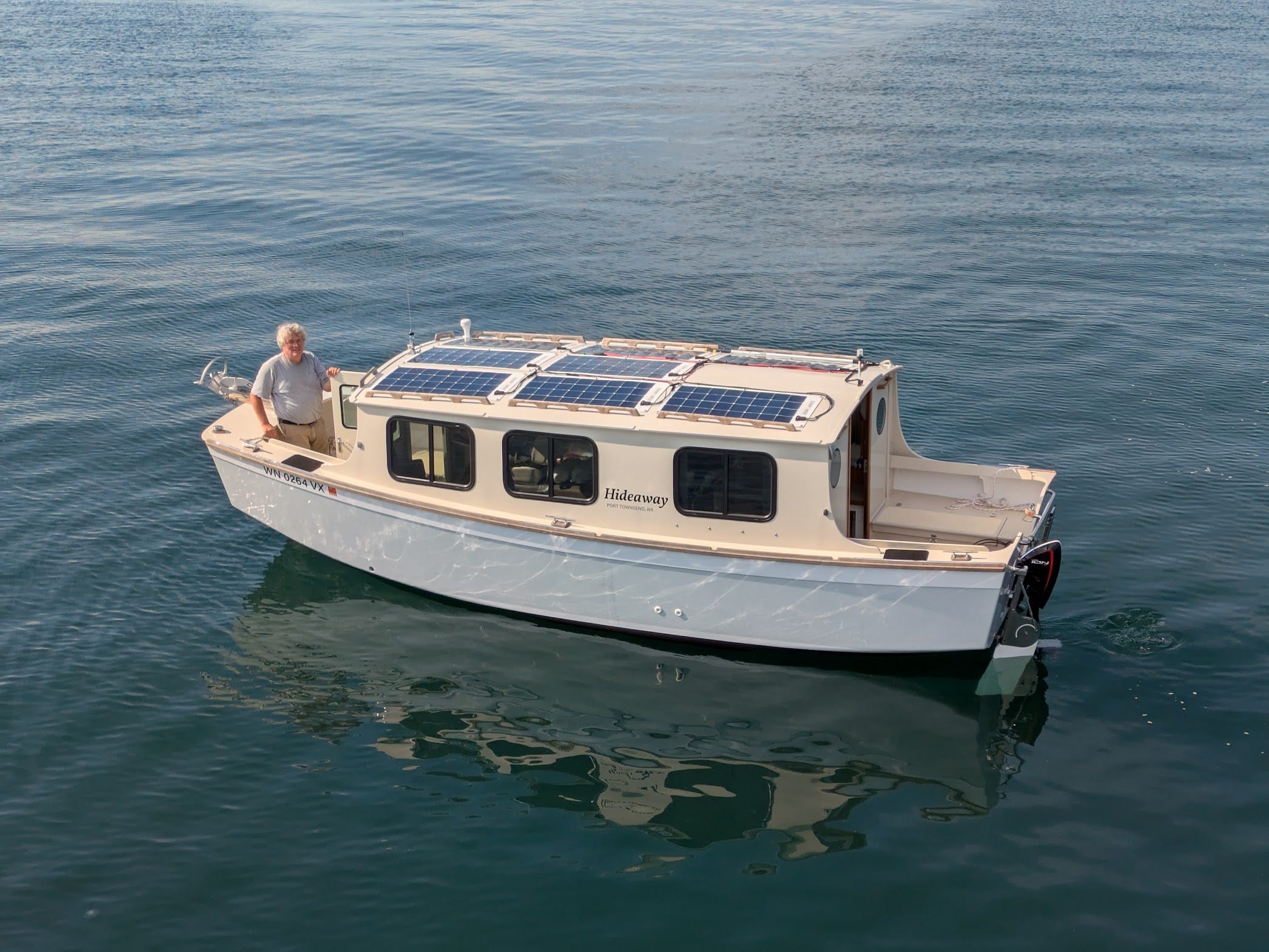
(Editor’s Note: Readers may remember that in December, 2024, SCA covered the design, construction and launch of HIDEAWAY, a solar-electric 22’ shantyboat designed for the owner by Sam Devlin, slightly modified by Brandon Davis of Turn Point Design in Port Townsend, and built by Kees Prins with help from Laingdon Schmidt. (Brandon’s changes were made due to the choice of windows, and to compensate for weight of the batteries and other equipment in the aft cockpit.) Below is a photo of the boat, with Kees aboard, taken recently by Ricki Ellen Brooke. Here is a follow-up from owner Chelcie, covering some speed-and-distance trials with the electric outboard, batteries installed and solar panels, along with a few other updates.)
By Chelcie Liu
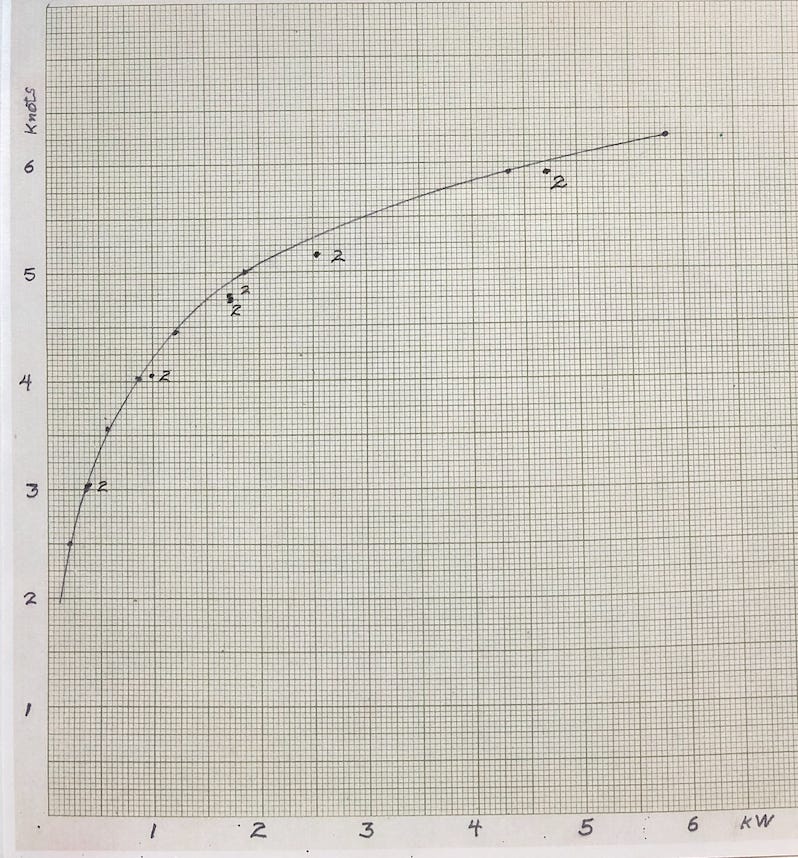
The two most frequent questions I’m asked about HIDEAWAY are: “How fast can she go?” and “How far can she go?” In order to answer these questions we need to know the power required to propel her at different speeds. Below is a graph showing HIDEAWAY’s speed, in knots, plotted against power consumed, in kW. The following procedure was used to obtain the data for this graph.
For each speed setting, data was recorded for two runs on headings that differed by 180 degrees. The throttle was not touched when her heading was reversed. The plotted speed is the average of the GPS speeds, shown on the Garmin chart plotter, for each heading used for a particular speed setting.
The power consumed for each speed setting was obtained from the “Service Menu” screen on the ION 6 motor’s helm display. Unfortunately, as the helm display is currently set up, this reading fluctuates rapidly as the motor is running. Thus, the helmsman gave me the highest and lowest power readings for each heading. The average of the highest and lowest power readings for each heading was then calculated. The plotted power value is the average of the two averages calculated for each heading for a particular speed setting.
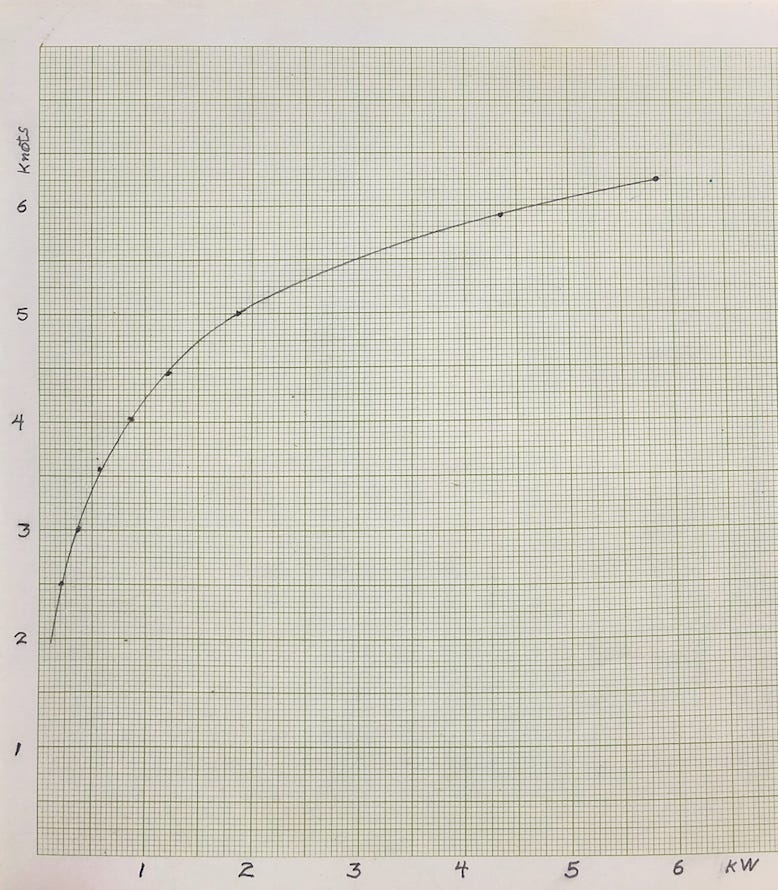
Looking at this graph, we see that the power required for a given speed change increases as the speed increases. In other words, it takes more power to change the speed by 0.5 knots the faster you go. For example, to change the speed from 2.0 to 2.5 Knots only takes about 100 Watts, while changing the speed from 4.0 to 4.5 Knots takes about 400 Watts, and changing the speed from 5.5 to 6.0 Knots takes about 1,750 Watts. By slowing down, the power consumption decreases much more than the speed. Thus, even though your speed decreases, your range increases because you can run for much longer.
A rule of thumb to find the best compromise between speed and range, for vessels moving at displacement speeds, is to take the square root of the waterline length, measured in feet, and change the units to knots. For example, if a boat has a waterline length of 25 feet, since the square root of 25 is 5, its best speed would be 5 knots. For HIDEAWAY this speed is ~4.5 knots. From the graph we see that at a speed of 4.5 knots the power consumption is ~1.25 kW. Her fully charged four 48 V, 96 Ah batteries store ~18.4 kWh of energy. Using 80% of this rated battery capacity, the range is ~53 nautical miles, without any solar charging. Actual range will depend on currents and winds, and the energy received from the solar panels.
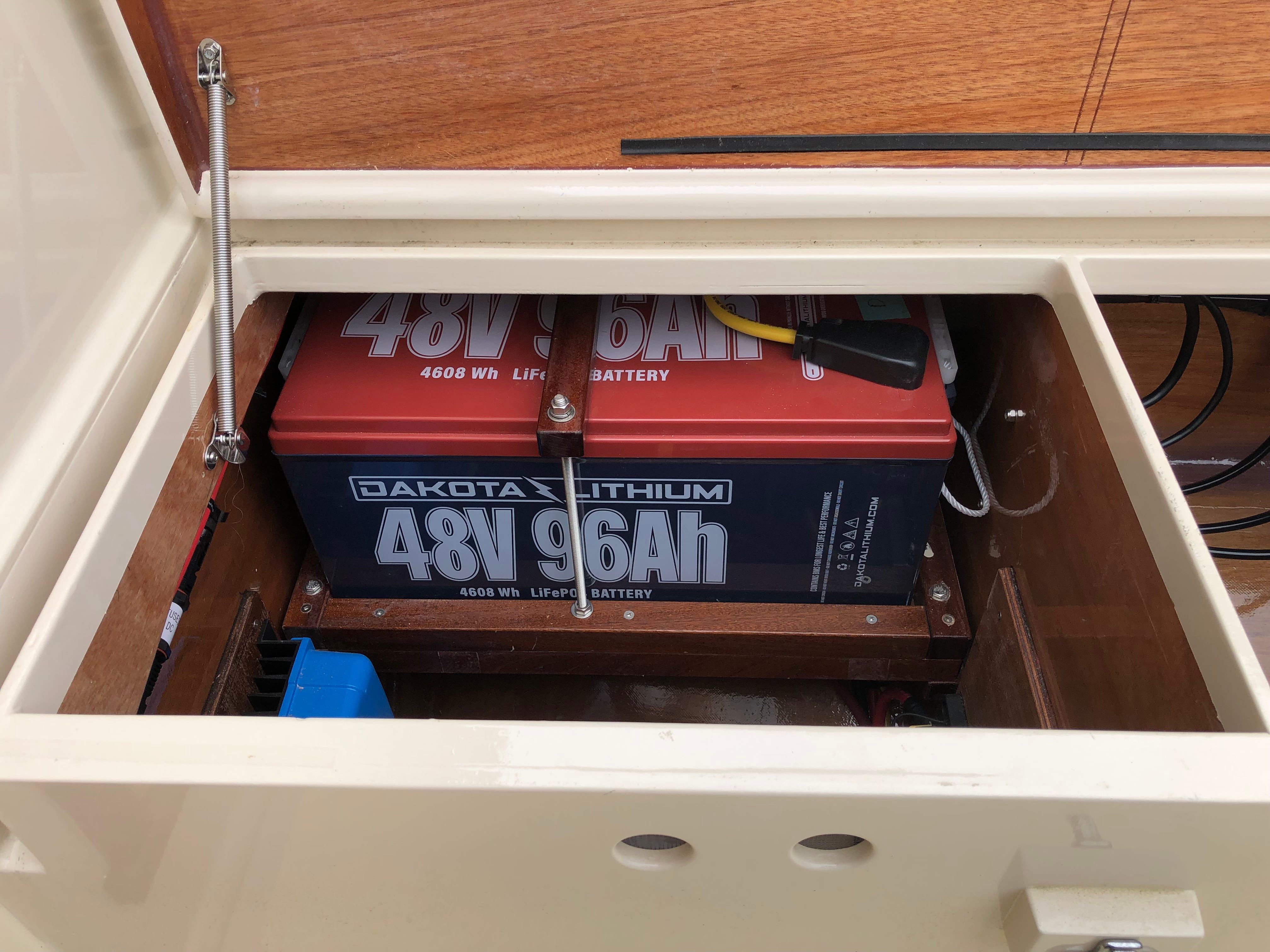
The photo below shows the 48 V battery under the aft cockpit seat on the starboard side. There is another one symmetrically placed under the port seat, and two more under the forward edge of the aft cockpit sole. These two batteries can be accessed by removing the aft cabin step.
Another set of questions I’m often asked is related to how far or fast the energy from the solar panels will move the boat. Twice, on a trip to and from Port Townsend to Port Ludlow—about 13 nautical miles—I found the net of the currents from the batteries and solar panels went to zero at a GPS speed of ~3.1 Knots (~50% of maximum speed) with the solar panels connected. These observations were made at a time and place where there was little or no wind, and I estimated minimal current. On August 24, 2025, the average GPS speed for runs on reciprocal courses was again ~3.1 knots for zero net current. I believe all three measurements were within one hour of noon, daylight savings time, on a sunny day. On a cloudy day, and at times when the sun was lower in the sky, the speed for zero net current would be lower.
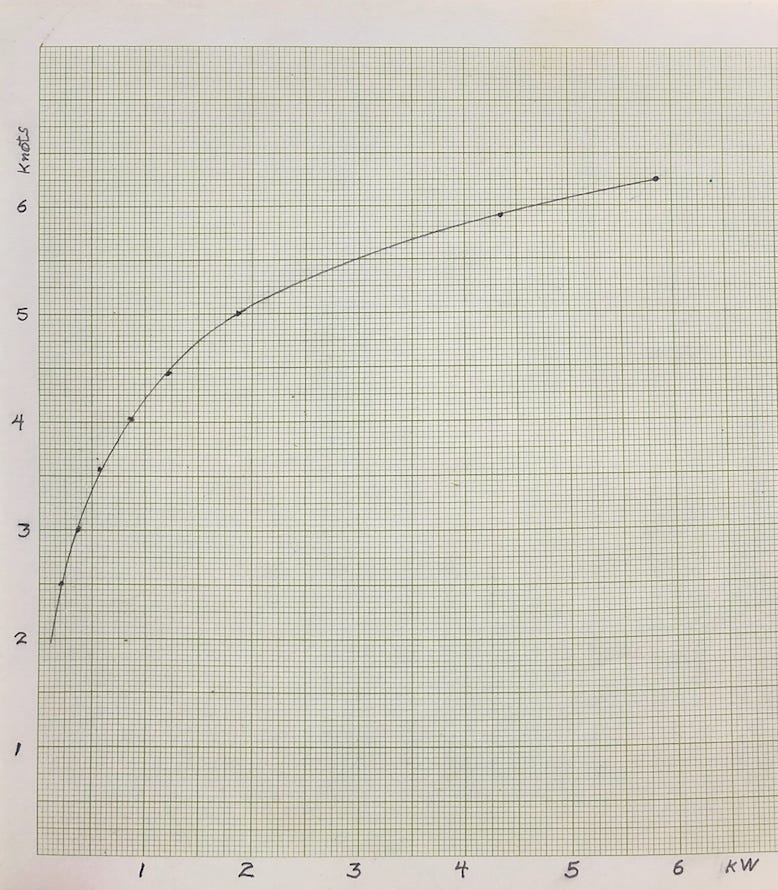
The data for the first graph was collected on April 30, 2025. She was launched in early April, so she should have had a clean bottom. On the second graph, below, the data for the points labeled “2” added to the first graph, was collected on August 24, 2025. I assumed the second set of points showed more power required for a particular speed because the bottom had acquired some soft growth since obtaining the data for the first set of points. (In fact, when we hauled HIDEAWAY on October 30, she did have some soft growth, that we removed before loading her on the trailer for winter storage.)
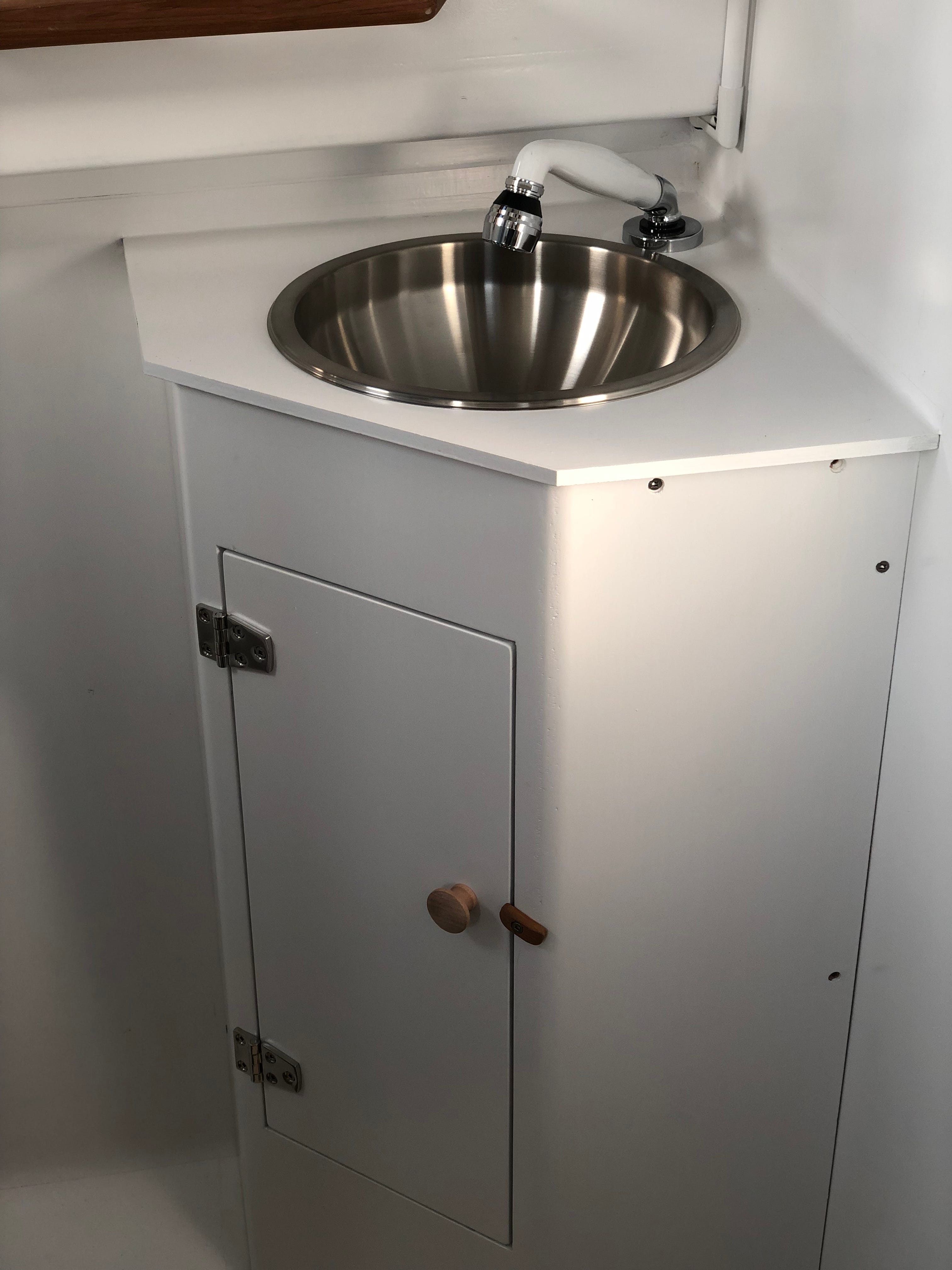
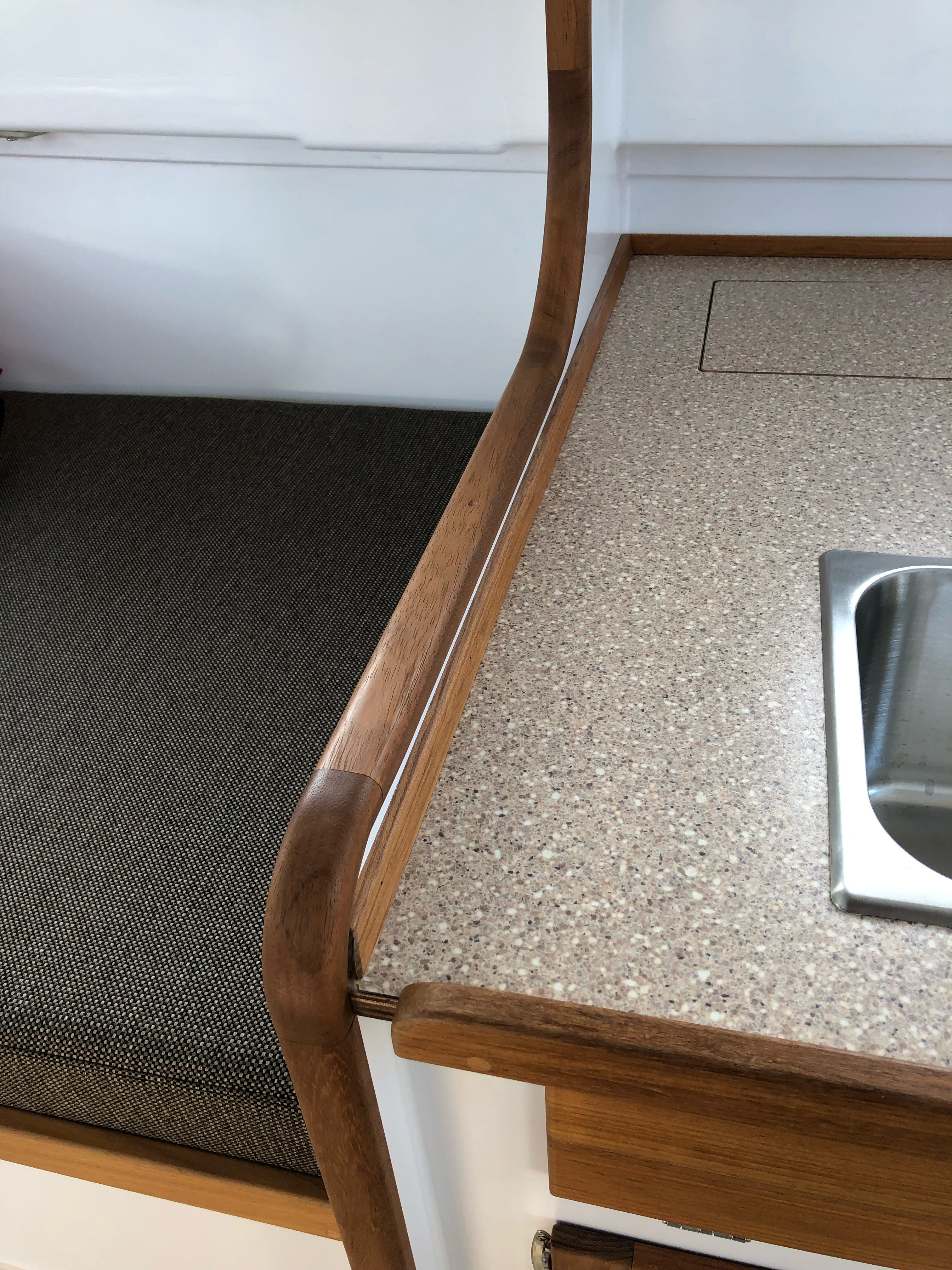
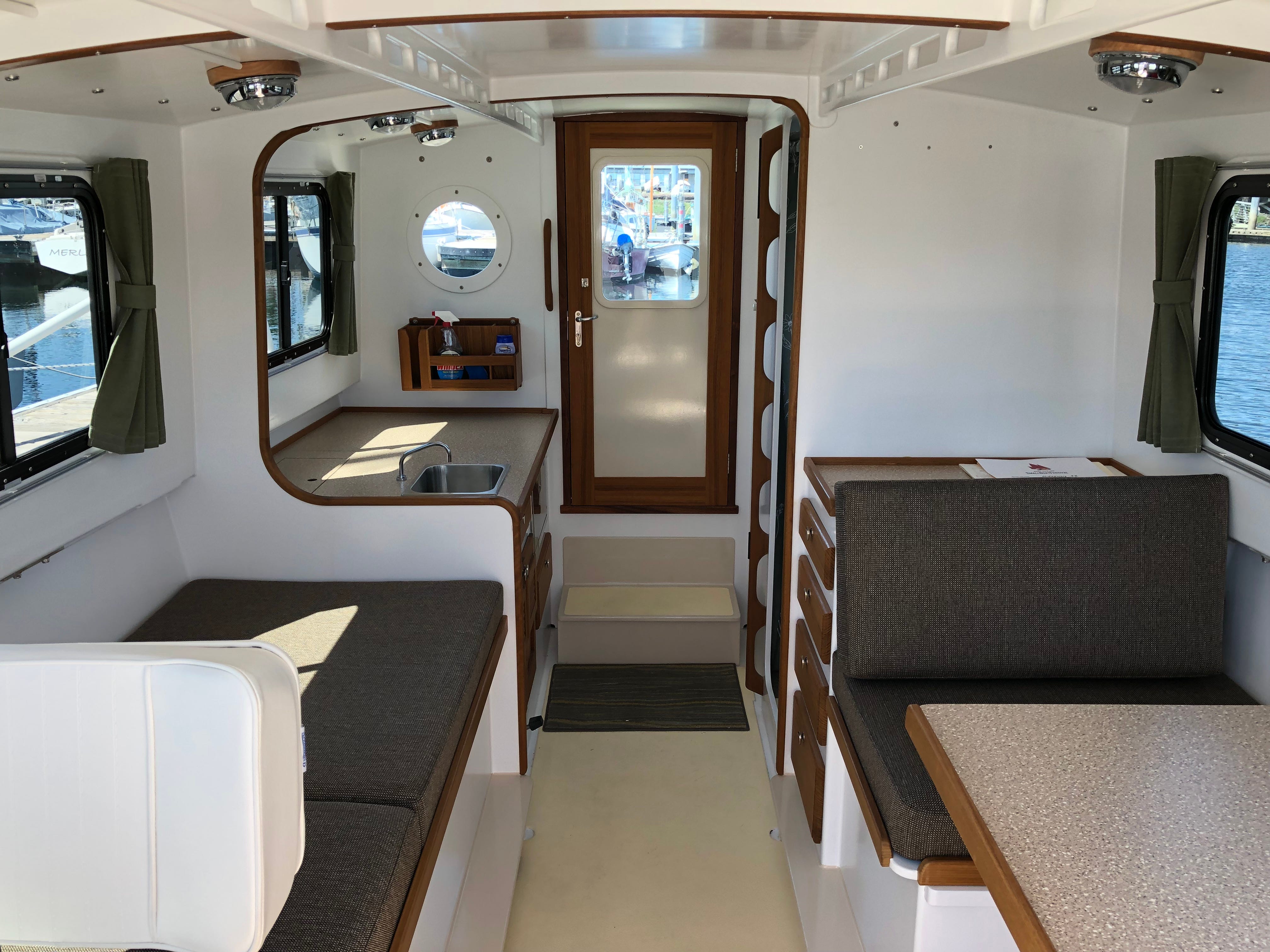
When HIDEAWAY was launched for the 2024 Wooden Boat Festival, the sink for the head and the trim for the edge of the bulkhead between the galley/head area and the rest of the cabin had not been installed. The two top photos below show the new head sink, and details of the new trim. Looking carefully at the third photo, you can see the wood trim on the edge of the bulkhead separating the galley and head from the rest of the cabin.
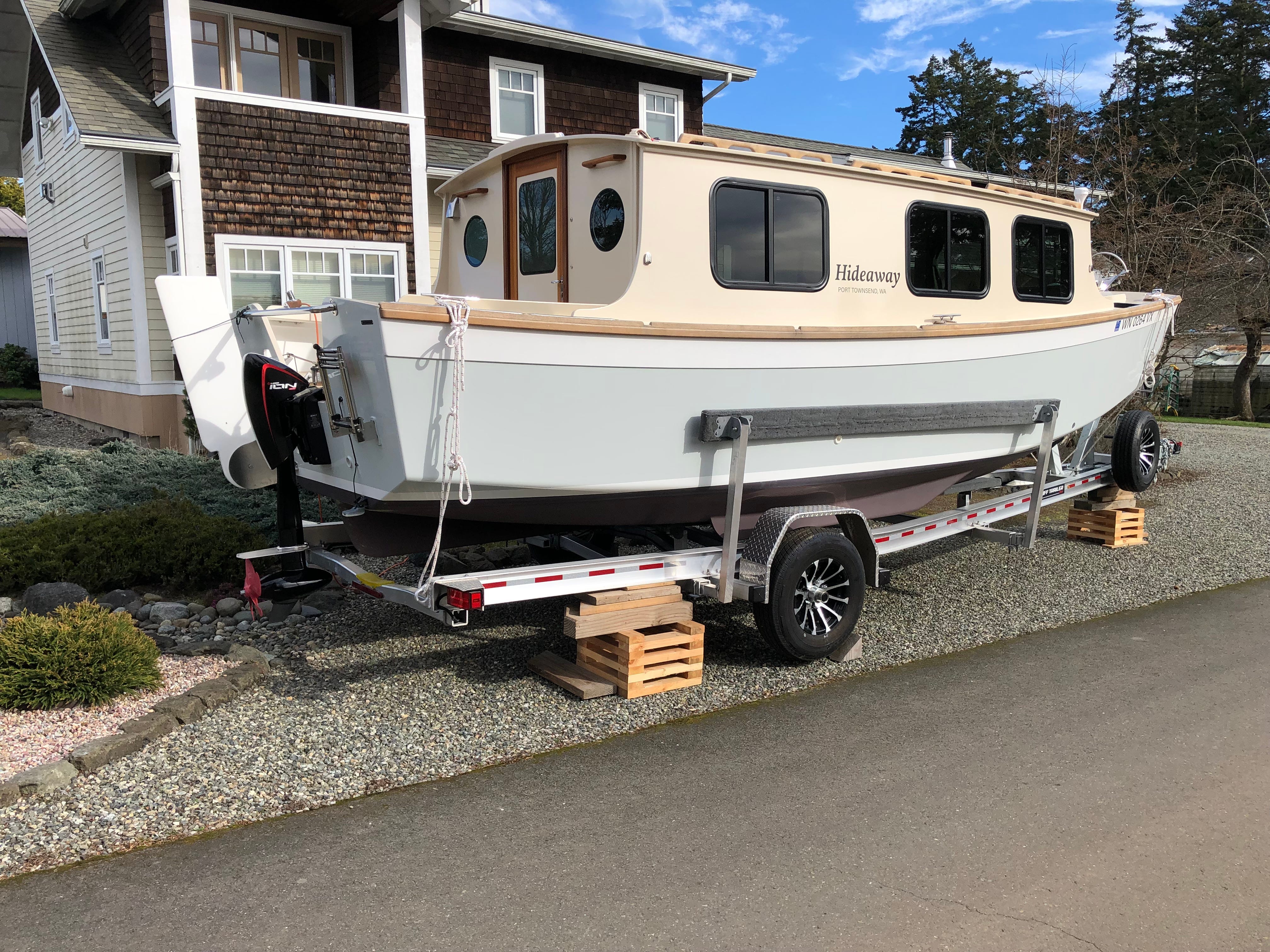
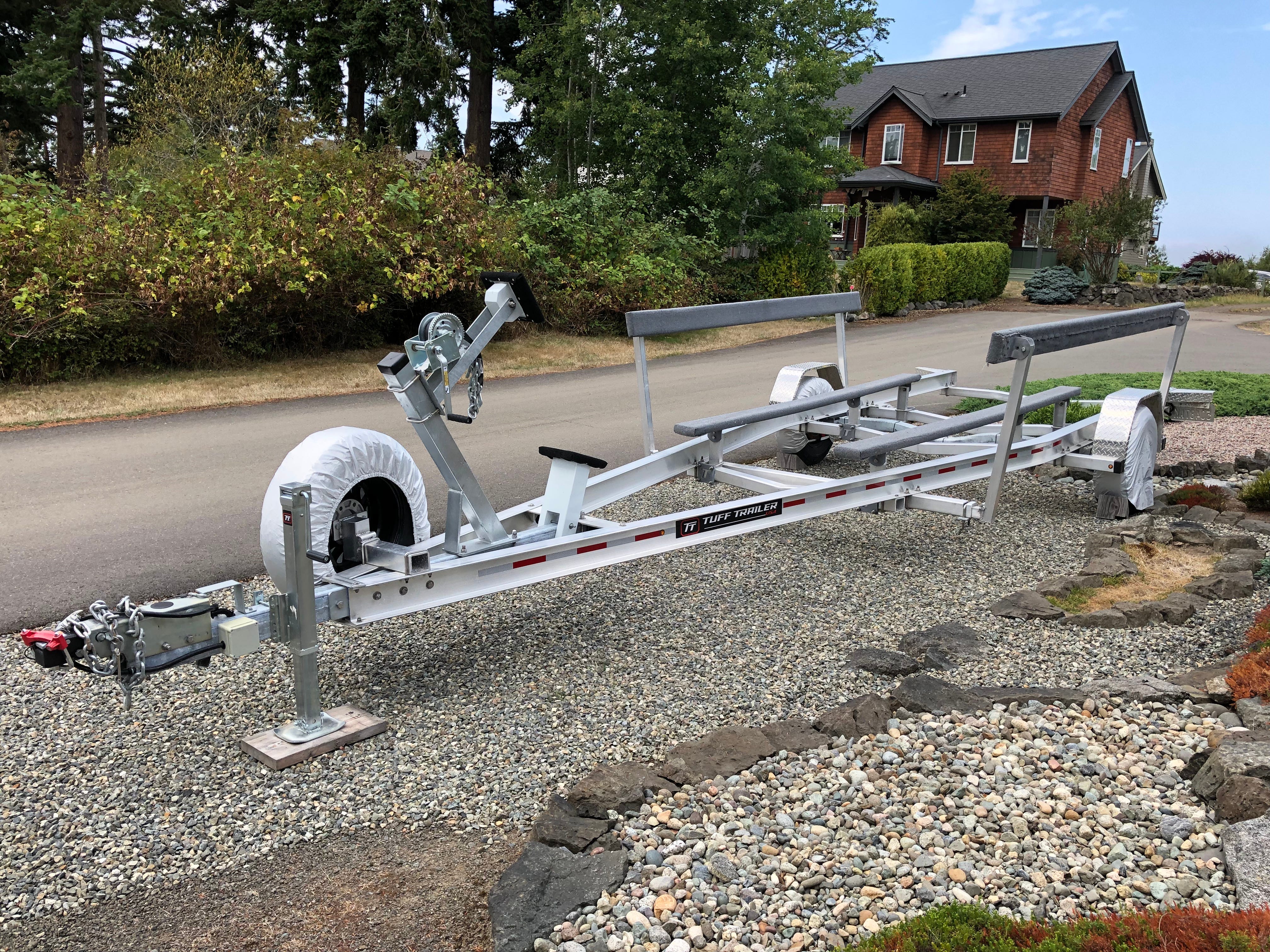
When moving HIDEAWAY from Kees’ shop to my house, we weighed the truck with boat and trailer attached, and the truck by itself. When launching her in April, we weighed the truck and trailer combination after she was launched, and the truck by itself. From these two sets of measurements, we calculated the following weights. Since HIDEAWAY has a maximum beam of 8.4’, she is towable by a vehicle with a towing capacity of 5,000 pounds. the photos below show HIDEAWAY on her aluminum trailer, and the trailer by itself.
2,950 lbs—Weight of boat when launched with empty water tanks and some gear. (Includes motor, new rudder, anchor and rode, boarding ladder, 50 feet of 30 amp Smart Plug to 3 prong twist lock power cord, and all cushions.)
3,380 lbs—After adding 20 gallons of water, about 170 lbs, and approximately 260 lbs of gear.
1,120 lbs—Weight of empty single axle Tuff aluminum trailer.
4,500 lbs—Approximate total trailering weight, fully loaded.
Thanks for publishing your data in a clear format, Chelcie...3 knots and drawing only 350 watts of power; 850 watts at 4 knots. Less than 2 kW running at more than "hull speed," if I'm reading the numbers right, even with a dirty bottom. Folks don't appreciate how LITTLE electrical power it actually takes to move a well-designed boat. Sounds like the Ilmor outboard is doing just fine. Any comments on prop selection?
Congratulations to the owner, designer and builders on constructing the interesting, electric propelled shantyboat “Hideaway”. Very respectfully, some comments in the article that one may wish to reconsider are the ones around an all in towing weight of 4,500 pounds and a towing capacity of the vehicle to tow at 5,000 pounds. That would be right on the line, with little margin for error. Especially when one has to take into account gross vehicle weights (“GVW”) that many different jurisdictions require in the calculations determining the correct towing capacity of a vehicle. GVW will include number and weight of passengers, weight of other gear within the vehicle, vehicle posted weight, and amount of fuel being carried plus the towed trailer weight. Also, a boat like Hideaway will be prone to having much more than 260 pounds of additional gear on board. The nicer, bigger bar-b-que, extra traps, maybe a small skiff on the boat deck, guest luggage and gear, etc. A vehicle with 7,000 to 7500 pounds towing capacity would be a safer, more practical choice with a decent margin for error. The difference in cost between a vehicle with a towing capacity of 5,000 pounds and one that has a rating of 7,000 - 7500 pounds is minimal. The slight extra cost would be well worth the peace of mind.
Once again, congratulations. Nice boat.